By ATGL
Updated March 28, 2025
[ez-toc]
The least squares method represents a fundamental mathematical technique used to determine the optimal way of fitting a curve to data points on a chart. In financial analysis and trading, this method provides a statistical foundation for identifying trends, making forecasts, and developing models that guide investment decisions. By minimizing the sum of squared differences between observed values and predicted values, the least squares method creates regression models that form the backbone of quantitative trading strategies and financial forecasting.
What Is the Least Squares Method?
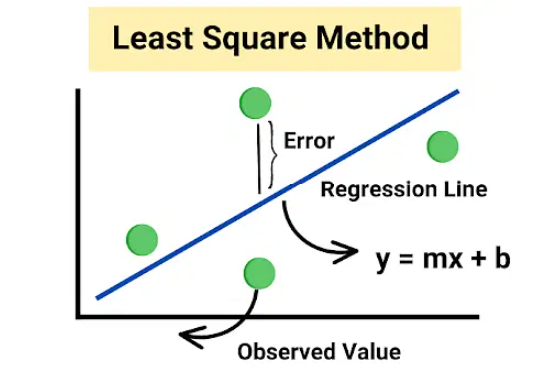
The least squares method is a mathematical technique that finds the optimal line of best fit by minimizing the sum of squared residuals — the vertical distances between actual data points and the fitted line. In finance, this method extracts meaningful patterns from market data, transforming scattered points into actionable trends. Analysts use it to calculate trend slopes and intercepts, providing quantitative signals for potential market overextensions or corrections that indicate strategic entry and exit points.
How Does the Least Squares Method Work?
The least squares method minimizes the sum of squared deviations between observed and predicted values, squaring both positive and negative deviations to prevent cancellation. Analysts collect financial data and plot points. Then, they apply algorithms to calculate optimal slope and intercept parameters. While typically producing a straight line for linear relationships, the method can be extended to fit polynomial curves or nonlinear functions for complex market patterns. This makes it versatile for various financial applications, from basic trend analysis to sophisticated market modeling.
The Least Squares Method Formula
The linear least squares method utilizes specific formulas to determine the slope and intercept of the line of best fit. For a simple linear regression model, the formula takes the form:
Y = mx + b
Where:
- Y represents the dependent variable (such as asset price)
- x represents the independent variable (often time)
- m represents the slope of the line
- b represents the y-intercept
The formulas for calculating the slope (m) and intercept (b) are:
m = [n∑(xy) – ∑x∑y] / [n∑(x²) – (∑x)²]
b = [∑y – m∑x] / n
Where:
- n is the number of data points
- ∑ denotes summation
- x and y are the variables
These calculations minimize the sum of squared residuals, expressed as:
∑(y – ŷ)²
Where ŷ represents the predicted value based on the regression line.
With these formulas, financial analysts obtain the parameters that define the line of best fit for their data, providing a mathematical foundation for trend analysis and prediction in trading activities.
Applications of Least Squares in Trading and Finance
- Linear Regression Models: Forms the foundation for identifying relationships between financial variables (stock prices/earnings, yields/inflation). Provide you with data-driven forecasts for more informed investment decisions.
- Ordinary Least Squares (OLS) Regression: Functions as the cornerstone for econometric analysis by quantifying relationships between multiple variables simultaneously. Critical for constructing factor models in portfolio management and risk assessment.
- Algorithmic Trading: Identifies entry and exit signals by detecting significant price deviations from regression-fitted trends. Creates opportunities in mean-reversion strategies similar to those in dividend growth strategy analysis.
- Macro Trading Signals: Models relationships between economic indicators and asset classes. Quantifies how GDP, inflation, or unemployment affect markets, guiding trading decisions during economic transitions.
- Least Squares Moving Average (LSMA): Projects price continuation by fitting regression lines to recent price points. Unlike traditional moving averages, it reduces lag in trend identification, providing earlier signals of potential market turns.
Implementing Least Squares Solutions
Financial professionals have access to multiple platforms and programming languages to implement least squares analysis. Each offers distinct advantages depending on the specific requirements and preferences of the analyst:
- Python Implementation: Utilizes NumPy, SciPy, and statsmodels libraries for robust regression capabilities supporting both simple and multiple models. Scikit-learn extends functionality with machine learning applications.
- R Applications: Features specialized statistical functions ideal for advanced econometrics. The lm() function delivers comprehensive outputs with statistical tests and diagnostics for model quality assessment.
- Excel Techniques: Provides accessibility for non-programmers through the LINEST() function and Analysis ToolPak. Includes visual charting capabilities for regression lines overlaid on financial data.
FAQs About the Least Squares Method
What Is an Example of the Least Squares Method?
A practical example involves plotting monthly stock prices for a company over several years and using the least squares method to determine the long-term trend. If the data shows prices of $50, $52, $55, $53, and $58 over five months, the least squares method would calculate the line of best fit, revealing the average monthly price increase. This trend line helps investors determine whether the stock is generally appreciating and at what rate.
What Is the Purpose of the Least Squares Criterion?
The least squares criterion serves to minimize the sum of squared differences between observed values and predicted values from a model. This approach provides several advantages in financial analysis: It penalizes larger errors more heavily than smaller ones, creates a mathematically optimal solution, and produces estimates with desirable statistical properties. The criterion helps financial models achieve the best possible fit to historical data.
When Should I Use Least Squares?
The least squares method proves most appropriate when analyzing relationships that approximate linear patterns, when working with data that contains random noise but has an underlying trend, and when the goal involves prediction or identification of correlations. In finance specifically, it works effectively for trend analysis, factor modeling, and regression-based trading strategies. However, it may be less suitable for highly volatile markets or when extreme outliers significantly distort results.
Enhancing Trading Strategies With Least Squares Method
The least squares method provides traders and financial analysts with a powerful tool for extracting meaningful signals from market data. By quantifying trends and relationships between variables, this technique brings mathematical rigor to the often subjective process of market analysis. These insights often complement other valuation approaches, such as the dividend growth model, by providing statistical validation of price movements.
When used properly, least squares analysis can identify overbought or oversold conditions, validate support and resistance levels, and generate objective trading signals based on deviations from established trends. These capabilities prove particularly valuable during periods of market uncertainty, when emotional responses might otherwise cloud judgment.
To maximize the benefits of least squares analysis in your trading approach, consider incorporating it into a comprehensive analytical framework that also accounts for fundamental analysis, market sentiment, and risk management. At Above the Green Line, we offer advanced educational resources and analytical tools that integrate least squares methods with other proven financial techniques.
Explore our membership options to gain access to professional-grade analytics and personalized guidance for implementing these powerful mathematical techniques in your investment strategy.

Related Articles
[pt_view id=”b47aec5l7b”]