By ATGL
Updated August 26, 2024
[ez-toc]
In technical analysis, traders constantly seek tools to assist their decision-making processes. The Double Exponential Moving Average (DEMA) stands out as a powerful indicator that addresses some limitations of traditional moving averages. This article details the intricacies of DEMA, exploring its formula, calculations, and applications in trading strategies.
What Is DEMA?
The Double Exponential Moving Average is an advanced technical indicator that reduces the lag inherent in traditional moving averages. Developed by Patrick Mulloy in 1994, DEMA provides a more responsive and accurate representation of price trends.
DEMA achieves this by using two exponential moving averages (EMAs) in its formula, effectively doubling the percentage of recent price data considered. This approach results in a smoother line that reacts more quickly to price changes compared to standard moving averages.
Double Exponential Moving Average Formula and Calculations
The DEMA formula might appear complex at first glance, but understanding its components helps clarify its functionality:
DEMA = 2 x EMA(n) – EMA(EMA(n))
Where:
- n is the number of periods
- EMA(n) is the n-period exponential moving average of the price
- EMA(EMA(n)) is the n-period exponential moving average of EMA(n)
To calculate DEMA:
- Compute the n-period EMA of the price data.
- Calculate another n-period EMA of the result from step 1.
- Multiply the first EMA by 2.
- Subtract the second EMA from the result of step 3.
This calculation method effectively reduces lag by giving more weight to recent price data while still considering historical trends.
Advantages of Using DEMA
DEMA offers several benefits that make it an attractive option for traders:
- Reduced Lag Compared to Other Averages: DEMA responds more quickly to price changes than simple moving averages (SMA) or standard EMAs.
- Better Trend Identification: The reduced lag allows you to identify potential trend reversals earlier, potentially leading to more timely entry and exit points.
- Improved Responsiveness to Price Changes: DEMA’s structure makes it more sensitive to recent price movements, helping you stay ahead of market shifts.
Applications of DEMA in Technical Analysis and Trading
DEMA finds various applications in technical analysis and trading strategies.
Identifying Trends
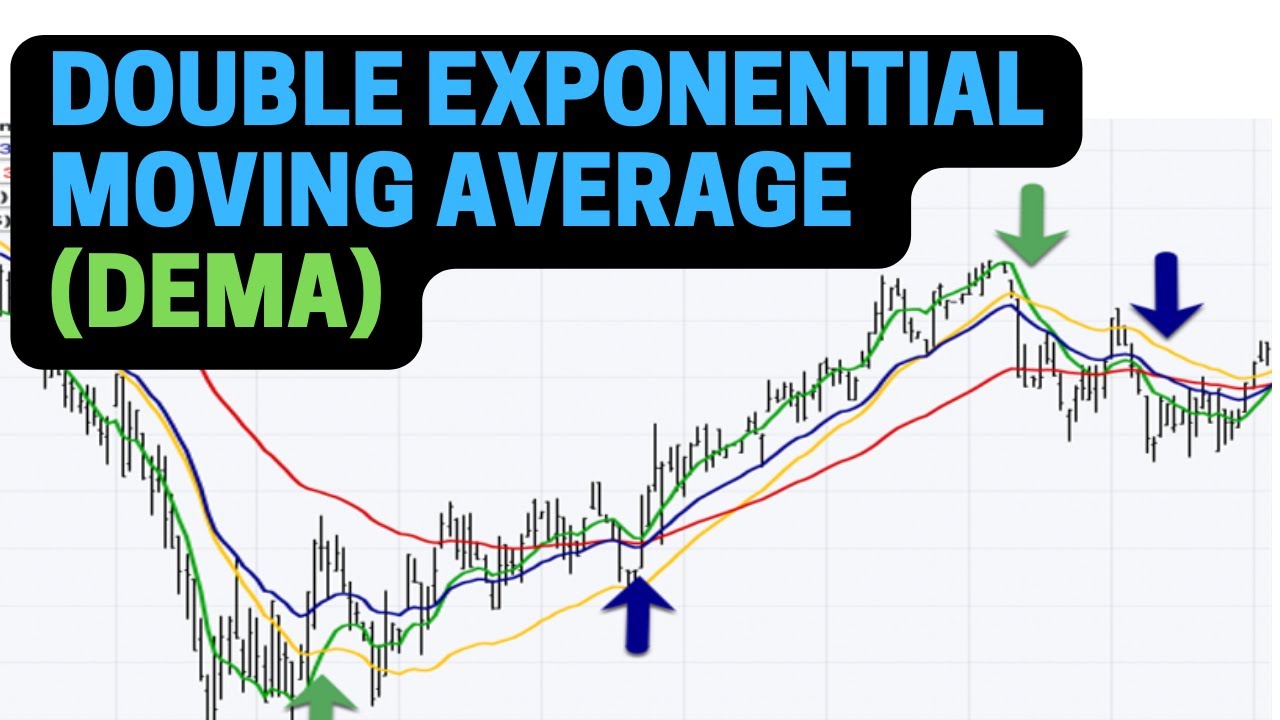
Traders often use DEMA to determine the overall market trend. When prices consistently stay above the DEMA line, it suggests an uptrend. Conversely, prices remaining below the DEMA line may indicate a downtrend.
Significance of Crossovers
DEMA crossovers can signal potential trend changes. When the price crosses above the DEMA line, it might indicate a bullish trend. A price crossing below the DEMA line could suggest a bearish trend.
Determining Support and Resistance Levels
DEMA can act as dynamic support and resistance levels. In uptrends, the DEMA line often serves as support, while in downtrends, it may act as resistance.
Incorporating DEMA Into Trading Strategies
To use a double exponential moving average effectively, you can:
- Combine DEMA with other indicators for confirmation. For instance, pairing DEMA with the Relative Strength Index (RSI) can provide insights into both trend direction and momentum.
- Use multiple DEMA periods to identify short-term and long-term trends. A common approach is to use a shorter-period DEMA (e.g., 20-day) for short-term trends and a longer-period DEMA (e.g., 50-day) for long-term trends.
- Implement DEMA in conjunction with volatility indicators for a more comprehensive market view. The Average True Range (ATR) can complement DEMA by helping traders gauge market volatility and set appropriate stop-loss levels.
- Use DEMA crossovers as potential entry or exit signals, while considering other factors like volume and market sentiment. For example, a price crossing above the DEMA coupled with increasing volume might provide a stronger buy signal.
- Apply DEMA to different timeframes to confirm trends across multiple time horizons. This multi-timeframe analysis can help traders align their short-term trades with longer-term market directions.
- Utilize DEMA for forecasting using moving averages in combination with other technical tools. This approach can provide a more robust framework for predicting potential price movements and market trends.
DEMA vs. Traditional Moving Averages
Understanding how DEMA compares to other moving averages helps you choose the most suitable tool for their strategies.
Comparison With Simple Moving Average
DEMA reacts more quickly to price changes than SMA. While SMA gives equal weight to all data points in its calculation period, DEMA emphasizes recent data, potentially providing earlier signals.
Comparison With Exponential Moving Average
The difference between EMA and double EMA lies in their responsiveness. DEMA is generally more responsive to price changes than standard EMA. This increased sensitivity can lead to earlier trend identification but may also result in more false signals in choppy markets.
Comparison With Triple Exponential Moving Average (TEMA)
TEMA applies the exponential moving average concept three times, potentially resulting in even less lag than DEMA. However, this further reduction in lag comes at the cost of increased complexity and potential oversensitivity to price movements.
Weaknesses of DEMA
While DEMA offers several advantages, it’s not without drawbacks:
- Increased Sensitivity: The reduced lag can lead to more false signals, especially in volatile or ranging markets.
- Complexity: DEMA’s calculations are more complex than those of simple moving averages, which can make it challenging for novice traders to interpret.
- Lagging Indicator: Despite its improvements, DEMA remains a lagging indicator, meaning it can still provide delayed signals in rapidly changing markets.
Apply Your Trading Strategies and Profit From Chart Movements
The Double Exponential Moving Average serves as a valuable tool in a trader’s arsenal, offering improved responsiveness and trend identification capabilities in financial markets. But remember to use it in conjunction with other technical analysis tools and fundamental research for a well-rounded trading approach. By understanding its formula, applications, and comparisons with other moving averages, you can make more informed decisions in your technical analysis.
To further enhance your trading strategies and leverage tools like DEMA effectively, consider exploring Above the Green Line’s membership options. Our comprehensive resources and expert insights can help you refine your approach to forecasting using moving averages and other advanced technical indicators.

Related Articles
[pt_view id=”9b64b383ox”]