
By ATGL
Updated October 20, 2024
[ez-toc]
By evaluating how effectively a company uses shareholders’ equity to generate profits, return on equity (ROE) helps assess the profitability and efficiency of a firm. In this article, we’ll cover the definition of ROE, how to calculate it, its significance in financial analysis, and its limitations, along with insights into how you can interpret and use this metric in your decision-making.
What Is Return on Equity?
ROE tells you about a company’s ability to generate profit from its shareholders’ equity, indicating how much profit a company produces with the money shareholders have invested. A higher ROE generally suggests that the company is using its equity efficiently to generate profits. It’s a widely used metric to evaluate corporate performance, particularly when comparing companies within the same industry.
Importance of ROE in Financial Analysis
ROE provides insight into how efficiently a company is using equity capital. It is particularly useful in comparing companies within the same industry. Here are some of the key ways ROE is applied:
- Profitability Measure: ROE reflects how well a company can convert equity investments into profits. This makes it an essential measure of corporate performance, especially for companies focused on maximizing shareholder returns.
- Investment Decisions: Investors often rely on ROE to compare the financial performance of different companies. A higher ROE generally signals a more efficient company, making it attractive to investors. Moreover, it complements other metrics, such as rate of return, which measures the efficiency of individual investments.
- Internal Benchmarking: Companies use ROE to evaluate their own performance over a period of time or benchmark it against competitors. A declining ROE may indicate inefficiencies or declining profitability.
Formula To Calculate Return on Equity
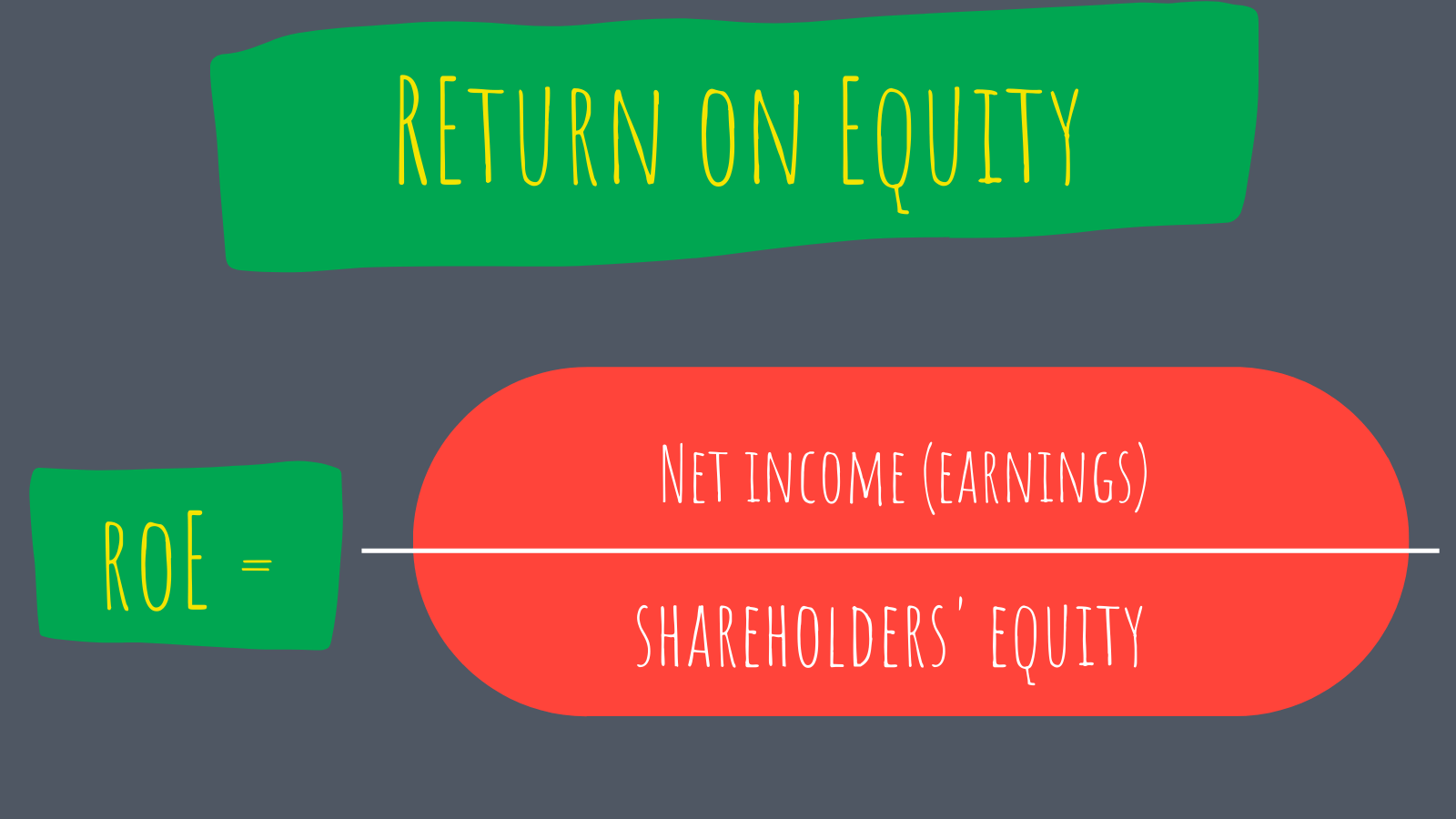
The standard formula for calculating ROE is:
ROE = (Net Income ÷ Shareholders’ Equity)
However, you should understand the components in detail:
- Net Income: This is the profit a company earns after accounting for all expenses, taxes, and costs.
- Shareholders’ Equity: This represents the owners’ claim after subtracting total liabilities from total assets.
Example Calculation
Consider a firm with a net income of $15 million and shareholders’ equity of $75 million:
ROE = (15,000,000 ÷ 75,000,000) = 0.20, or 20%
This ROE of 20% indicates that the company is generating $0.20 of profit for every dollar of equity invested by shareholders.
Key Drivers of ROE
- Profitability: The company’s ability to generate profits directly impacts ROE. Firms with high profit margins tend to have higher ROEs.
- Efficiency: How well a company uses its assets affects its ROE. Efficient companies use their assets effectively to generate revenue, boosting ROE.
- Leverage: The use of debt can influence ROE. Higher leverage (debt) can amplify ROE as long as the company earns more from its debt than it pays in interest. However, excessive debt can also increase risk.
Limitations of ROE
Impact of Debt Levels
Companies with high debt can artificially inflate their ROE. This is because shareholders’ equity is reduced when debt levels rise, leading to a higher ROE. However, the potential risk of financial distress increases with excessive leverage.
Negative Net Income
If a company reports a net loss, the ROE will be negative. This can distort comparisons with other firms and give a misleading view of a company’s performance. In such cases, additional metrics, such as the fair value of stock, should be considered to gain a more comprehensive understanding.
Industry Variations
Return on equity can vary widely across industries. Capital-intensive sectors like utilities and manufacturing typically have lower ROEs, while technology companies may have much higher figures. Therefore, you should compare ROE within the same industry to get meaningful insights.
Decision-Making for Investors: Interpreting ROE
ROE can play a significant role in guiding investment decisions. However, consider what constitutes a “good” ROE and how to interpret the metric effectively.
What Constitutes a Good Return on Equity Ratio?
A “good” ROE depends on the industry and the company’s peers. For instance, an ROE of 15% might be excellent for a utility company but average for a tech firm. As a general rule, an ROE above 15% is often considered favorable.
Contextual Factors Affecting ROE Interpretations
- Company Life Stage: Younger companies may have lower ROE due to high growth costs, while mature firms might have higher ROEs as they focus on efficiency.
- Economic Conditions: During economic downturns, ROE can decline across sectors, so it’s essential to factor in broader market conditions when evaluating ROE.
ROE Across Different Industries
Industry norms play a key role in interpreting ROE. For example, high-growth industries like technology often exhibit higher ROEs due to their ability to scale and generate large profits. Conversely, industries with significant capital investments, such as energy, tend to have lower ROEs.
Find the Information You Need To Improve ROE
Improving ROE involves enhancing profitability, increasing efficiency, and managing leverage effectively. Companies can optimize their ROE by focusing on operational improvements, disciplined financial management, and prudent capital allocation. If you’re interested in identifying companies with strong ROE metrics, consider exploring factor investing strategies, which target firms with solid financial fundamentals, or learning how to evaluate the fair value of stock based on ROE performance.
If you’re looking for expert insights and personalized tools to help improve your investment decisions, consider becoming a member of Above the Green Line. Our membership offers exclusive access to in-depth analysis, stock recommendations, and proprietary metrics designed to help you invest with confidence.
FAQs About ROE
What Does a High ROE Mean?
A high ROE typically indicates that a company is effectively generating profit from its equity. However, excessively high ROEs may be a red flag for excessive leverage or one-time gains.
What’s the Difference Between ROI and ROE?
ROI measures the efficiency of an individual investment, while ROE evaluates a company’s ability to generate profit relative to shareholders’ equity. ROI is typically more focused on specific projects or asset performance.
What Is a Good ROE Financial Ratio?
Generally, an ROE above 15% is considered strong, though this varies by industry and company lifecycle.

Related Articles
[pt_view id=”b47aec5l7b”]