By ATGL
Updated May 7, 2025
[ez-toc]
The Moving Average Convergence Divergence (MACD) indicator is one of the most widely used technical analysis tools available to traders. This momentum oscillator tracks the relationship between two moving averages of a security’s price, helping you identify potential trend changes and momentum shifts. Understanding how to interpret and apply MACD signals effectively can significantly enhance trading strategies across various markets and timeframes.
Understanding Moving Averages
Moving averages calculate the average price of a security over a specified time period, creating a smoothed line that filters out short-term price fluctuations. These technical tools help you identify trends by averaging prices over time. Two common types are Simple Moving Averages (SMA), which weigh all prices equally, and Exponential Moving Averages (EMA), which assign greater weight to recent prices. The MACD utilizes these EMAs to generate its signals.
What Is the MACD Indicator?
The MACD indicator functions as a momentum oscillator that detects changes in the strength, direction, momentum, and duration of price trends. Developed by Gerald Appel in the late 1970s, this trading indicator calculates the mathematical relationship between two exponential moving averages.
The standard MACD calculation subtracts the 26-period EMA from the 12-period EMA. The formula is expressed as:
MACD Line = 12-period EMA – 26-period EMA
This calculation produces the main MACD line, which oscillates above and below a zero line. Additionally, a 9-period EMA of the MACD line itself creates the “signal line,” which serves as a trigger for buy and sell signals.
Signal Line = 9-period EMA of MACD Line
The difference between the MACD line and the signal line forms the histogram, visually representing the distance between these two lines.
How To Read a MACD Indicator
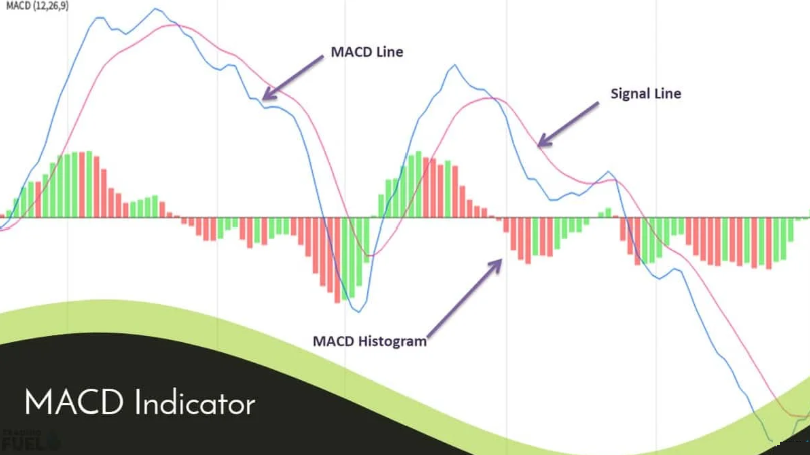
The MACD indicator consists of three primary components that traders analyze to make investment decisions:
- MACD Line: This main line reflects the difference between the short-term and long-term EMAs (typically 12 and 26 periods), measuring momentum shifts in the price.
- Signal Line: This secondary line represents the 9-period EMA of the MACD line itself, functioning as a trigger mechanism for buy and sell signals.
- Histogram: This bar chart depicts the distance between the MACD line and the signal line. When the MACD line crosses above the signal line, the histogram becomes positive. When it crosses below, the histogram turns negative.
The use of MACD on stock charts typically displays these components together, with the MACD and signal lines appearing as overlapping curves and the histogram as vertical bars. The positioning of these elements relative to the zero line and each other generates various trading signals.
What Are the Key Signals of the MACD Indicator?
The MACD generates several distinct signals that you can use to identify potential market entries and exits.
Crossover Signals
- Signal Line Crossover: When the MACD line crosses above the signal line, it generates a bullish signal; conversely, a crossover below the signal line indicates a bearish signal.
- Zero Line Crossover: When the MACD line moves above the zero line, it suggests bullish momentum; when it falls below, it indicates bearish momentum.
- Dual MACD Crossover: This strategy involves monitoring both types of crossovers simultaneously for stronger confirmation.
Divergence Signals
- Regular Divergence: Occurs when the price creates new highs or lows, but the MACD fails to confirm these extremes, potentially signaling a reversal.
- Hidden Divergence: Appears when the price makes a higher low in an uptrend or a lower high in a downtrend, while the MACD makes a lower low or higher high, respectively, often indicating continuation.
- Exaggerated Divergence: Presents when the divergence becomes particularly pronounced, potentially signaling a stronger reversal.
Traders who trade RSI-MACD divergence often find these signals particularly powerful when confirmed by multiple indicators.
How To Use the MACD Indicator
Employing the MACD involves several practical strategies.
Entry and Exit Signals
- Enter long positions when the MACD line crosses above the signal line, especially if this occurs below the zero line (indicating a potential shift from bearish to bullish).
- Exit long positions or enter short positions when the MACD line crosses below the signal line, particularly if this happens above the zero line.
- Utilize divergences as early warning signs of potential trend reversals.
Multiple Timeframe Analysis
- Apply the MACD across different timeframes to confirm signals.
- Look for alignment of MACD signals on higher and lower timeframes to strengthen confidence in trade decisions.
- Use longer timeframes for trend direction and shorter timeframes for entry timing.
Combining MACD With Other Indicators
- Pair the MACD with trend-following indicators like moving averages to validate the underlying trend.
- Combine with oscillators such as the Relative Strength Index (RSI) to confirm overbought or oversold conditions.
- Integrate with volume indicators to verify the strength behind MACD signals.
Benefits and Limitations of MACD
Benefits
- The MACD effectively identifies momentum shifts in various market conditions.
- Its visual presentation makes trend changes relatively straightforward to interpret.
- The indicator works across multiple timeframes and financial instruments.
- The MACD provides both trend and momentum information in a single indicator.
Limitations
- Like all oscillators, the MACD can generate false signals, particularly in sideways or choppy markets.
- The standard settings may not be optimal for all securities or timeframes, requiring adjustment.
- The MACD operates with a lag, as it relies on moving averages, potentially delaying entry or exit signals.
- During strong trends, the indicator may remain in overbought or oversold territory for extended periods.
Implementing MACD In Your Investment Strategy
Integrating the MACD indicator into your trading approach requires methodical testing and adaptation. Begin by applying the standard settings (12, 26, 9) to historical data of your preferred securities, noting how accurately the signals would have predicted actual price movements. Gradually adjust these parameters to potentially enhance performance for specific assets or timeframes.
Focus on establishing clear rules for entries, exits, and risk management based on MACD signals. Consider allocating only a portion of your portfolio to MACD-based strategies initially, increasing this allocation as you confirm effectiveness. Document and analyze both successful and unsuccessful trades to refine your implementation.
For traders seeking comprehensive technical analysis systems that incorporate the MACD alongside other powerful indicators, Above the Green Line offers specialized memberships designed to optimize your trading performance. These professional resources provide structured frameworks for implementing momentum-based strategies across various market conditions, helping you transform technical signals into actionable trading plans. Explore our membership options and enhance your trading strategy today.

Related Articles
[pt_view id=”9517038dwu”]