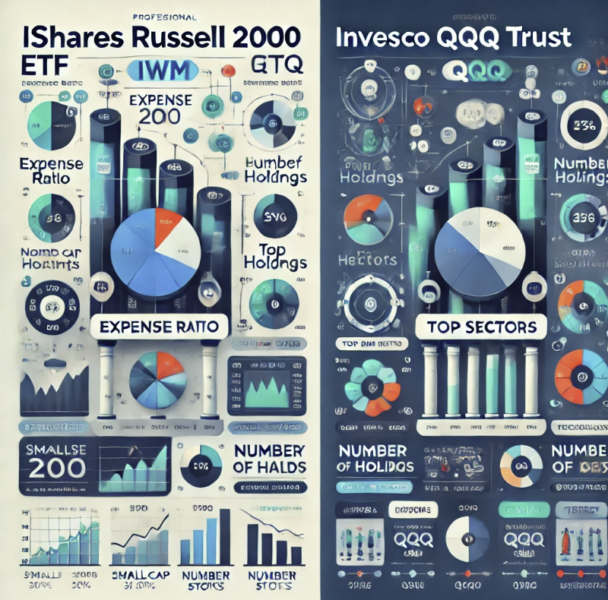

View our active allocation. We hold the top 3 strongest sectors (like Tech, Energy, or Healthcare) and rebalance monthly based on relative strength.
Learn the mechanics behind the "Rotation." How we use Relative Strength (RS) scores to identify leaders and cut laggards.
Exchange-Traded Funds (ETFs) are investment funds that are traded on stock exchanges, similar to individual stocks. ETFs combine features of both mutual funds and stocks, offering investors a convenient and cost-effective way to gain exposure to a diversified portfolio of assets. These assets can include stocks, bonds, commodities, or a combination of various asset classes.
ETFs are typically structured as open-end investment companies or unit investment trusts. They issue shares that represent ownership in the underlying assets.
ETF shares are created and redeemed through a process called “creation units.” Authorized participants, often large institutional investors, can exchange baskets of underlying assets for new ETF shares or vice versa. This process helps maintain the ETF’s market price close to its net asset value (NAV).
ETFs are bought and sold on stock exchanges throughout the trading day at market prices. The market price may differ slightly from the NAV due to supply and demand factors, but the creation/redemption process helps minimize these deviations.
Exchange-Traded Funds (ETFs) offer a versatile investment vehicle that can be used in various trading strategies. Unlike traditional mutual funds, ETFs trade on exchanges like stocks, enabling investors to employ a range of tactical approaches. Here are several effective strategies for trading ETFs, catering to different market conditions and investment goals.
Many ETFs track specific indexes, allowing investors to passively invest in the performance of an entire market or sector. This strategy is known as index investing and is popular among those seeking broad market exposure.
Some ETFs follow factor-based investing strategies, focusing on specific investment factors like value, momentum, or quality to potentially outperform the broader market.
The buy-and-hold strategy is one of the simplest and most effective ways to invest in ETFs. This long-term approach involves purchasing shares of an ETF and holding onto them for an extended period, regardless of short-term market fluctuations. Investors typically choose ETFs that track broad market indices, sector funds, or thematic ETFs aligned with long-term trends. This strategy benefits from the compounding of returns over time and reduces transaction costs associated with frequent trading. By focusing on quality ETFs with strong historical performance, investors can harness the power of market growth while minimizing the emotional stress of market volatility.
The sector rotation strategy involves shifting investments among different sectors of the economy based on anticipated performance. Investors analyze economic indicators, market cycles, and sector trends to identify which sectors are likely to outperform in the current environment. For example, during periods of economic expansion, cyclical sectors like technology and consumer discretionary may thrive, while in a recession, defensive sectors like utilities and healthcare may be more stable. By using sector-specific ETFs, traders can capitalize on these trends, buying into sectors poised for growth while reducing exposure to underperforming ones.
Pairs trading is a market-neutral strategy that involves trading two correlated ETFs. Traders identify two ETFs that typically move together due to similar underlying assets or market conditions. When the price relationship between these two ETFs diverges—meaning one ETF becomes overvalued while the other is undervalued—traders will buy the undervalued ETF and short the overvalued one. This strategy aims to profit from the convergence of their prices back to historical norms. Pairs trading can be particularly effective in volatile markets where price discrepancies arise, allowing traders to hedge against market risk while potentially generating returns.
Many traders use technical analysis to make decisions about buying or selling ETFs. This approach involves analyzing price charts, volume trends, and various technical indicators, such as moving averages, Relative Strength Index (RSI), and Bollinger Bands. By studying these indicators, traders can identify patterns and trends that may indicate potential entry or exit points. For instance, if an ETF is trading above its 50-day moving average and shows strong momentum, it may be a signal to enter a long position. Conversely, if an ETF falls below its support level, it might indicate a good opportunity to short the ETF or exit a long position.
Dollar-cost averaging is a risk management strategy that involves investing a fixed amount of money in an ETF at regular intervals, regardless of the ETF’s price. This approach helps to reduce the impact of market volatility, as it spreads out purchases over time. Investors benefit by buying more shares when prices are low and fewer shares when prices are high, effectively lowering their average cost per share. This strategy is particularly beneficial for long-term investors who want to mitigate the risks associated with timing the market while steadily building their positions in chosen ETFs.
Trading ETFs offers investors a wide array of strategies to fit their individual goals and market conditions. Whether employing a buy-and-hold approach, engaging in sector rotation, or utilizing technical analysis, traders can leverage the unique characteristics of ETFs to optimize their investment outcomes. By understanding and implementing these strategies, investors can effectively navigate the complexities of the market, manage risks, and capitalize on opportunities presented by ETFs. As always, it’s essential to conduct thorough research and stay informed about market trends to make informed trading decisions.
Before investing in ETFs or any financial product, it’s crucial for investors to thoroughly research and understand the specific ETF’s objectives, strategy, and associated risks. It’s also advisable to consider consulting with a financial advisor to tailor an investment strategy that aligns with individual financial goals and risk tolerance. Above the Green Line provides a number of articles about ETF’s along with a Beginners Guide for Investment Strategies using ETFs.
A snapshot of the daily updates that help traders stay aligned with market direction.
Above The Green Line’s systematic approach has completely transformed my trading. I’ve gone from inconsistent results to reliable gains, even during market downturns.”
The systematic approach has been a game-changer for my portfolio. I no longer second-guess my trading decisions and have seen consistent returns even in volatile markets.”
Sarah K.
Michael R.
Engineer & Part-time Trader
The community aspect is invaluable. Being able to learn from experienced traders and discuss strategies in real-time has accelerated my trading knowledge tremendously.
David L.
Business Owner


