• Market Insights
        • Commentary
          • Daily
          • Weekly
        • BUY / SELL SIGNALS
          • Trade Posts
          • Recent Trade Alerts
          • Recent Day Trades
        • BLOGROLL
          • Dividend Growth Blog
          • ETF Sector Blog
          • Dow Dogs
          • TPOW Blog
  • Strategies
        • SWING TRADING
          • Current Positions
          • Watchlists
          • Closed Positions
          • Candidates - TOP 100
          • Specialty Stocks
        • WEEKLY STOCK PICK
          • TPOW Charts
          • TPOW Performance
          • TPOW Strategy Guide
          • TPOW Performance Dashboard
        • DAY TRADING
          • Watch List
        • ATGL DASHBOARD
        • ETF STRATEGIES
          • ETF Sector Rotation
          • ETF Sector Portfolio
        • DIVIDEND GROWTH
          • Dividend Growth Portfolio
          • Dividend Calendar
        • DOGS OF THE DOW
          • Dogs of the Dow Portfolio
          • DOW 5 Portfolio
  • Markets
        • US MARKET
          • Commodities
          • Energy
          • Precious Metals
          • Volatility
        • GLOBAL MARKETS
          • Market Indices
          • Economic Calendar
          • FOREX Heat Map
          • FOREX Cross Rates
          • Crypto Currency Market
  • Investing
    • Discord Community
    • Dashboard
  • Resources
        • ARTICLES
          • Dividend Growth Model Articles
          • ETF Articles
          • Investment Strategies Articles
          • Market and Economic Insights
          • Stock Trade Articles
          • Stock Reviews
        • TOOLS
          • Stock Scanners
          • Charting Software
          • Brokerage Firms
        • STOCK CHARTS
          • Key Components
          • Reading Charts
          • Drawing Stock Charts
          • Identifying Trends
        • RETIREMENT PLANNING
  • About
    • Contact Us
    • How to Win
    • #1 At Stockcharts
    • Disclaimer
    • FAQ
  • Log In
  • Subscribe
Menu
  • Market Insights
    • Commentary
      • Daily
      • Weekly
    • BUY / SELL SIGNALS
      • Trade Posts
      • Recent Trade Alerts
      • Recent Day Trades
    • BLOGROLL
      • Dividend Growth Blog
      • ETF Sector Blog
      • Dow Dogs
      • TPOW Blog
  • Strategies
    • SWING TRADING
      • Current Positions
      • Watchlists
      • Closed Positions
      • Candidates – TOP 100
      • Specialty Stocks
    • DAY TRADING
      • Watch List
    • WEEKLY STOCK PICK
      • TPOW Charts
      • TPOW Performance
      • TPOW Strategy Guide
      • TPOW Performance Dashboard
    • DIVIDEND GROWTH
      • Dividend Growth Portfolio
      • Dividend Calendar
    • DOGS OF THE DOW
      • Dogs of the Dow Portfolio
      • DOW 5 Portfolio
    • ETF STRATEGIES
      • ETF Sector Rotation
      • ETF Sector Portfolio
    • ATGL DASHBOARD
  • Markets
    • US MARKET
      • Commodities
      • Energy
      • Precious Metals
      • Volatility
    • GLOBAL MARKETS
      • Market Indices
      • Economic Calendar
      • FOREX Heat Map
      • FOREX Cross Rates
      • Crypto Currency Market
  • Investing
    • Discord Community
    • Dashboard
  • Resources
    • ARTICLES
      • Dividend Growth Model Articles
      • ETF Articles
      • Investment Strategies Articles
      • Market and Economic Insights
      • Stock Trade Articles
      • Stock Reviews
    • TOOLS
      • Stock Scanners
      • Charting Software
      • Brokerage Firms
    • STOCK CHARTS
      • Key Components
      • Reading Charts
      • Drawing Stock Charts
      • Identifying Trends
    • RETIREMENT PLANNING
  • About
    • Contact Us
    • How to Win
    • #1 At Stockcharts
    • Disclaimer
    • FAQ
  • Log Out
    • Members-Page
    • Referral
  • Log In
  • Subscribe
Log In
Log Out
Subscribe

April 2, 2025

Double Top Pattern: How to Identify and Trade This Reversal Signal
Double Top Patterns

By ATGL

Updated April 2, 2025

The double top pattern ranks as one of the trading patterns you should know when conducting technical analysis. This formation appears frequently across various timeframes and markets, serving as a powerful bearish reversal signal that experienced traders monitor closely. Understanding this pattern provides valuable insight into potential market direction shifts and offers strategic trading opportunities.

What Is a Double Top Pattern?

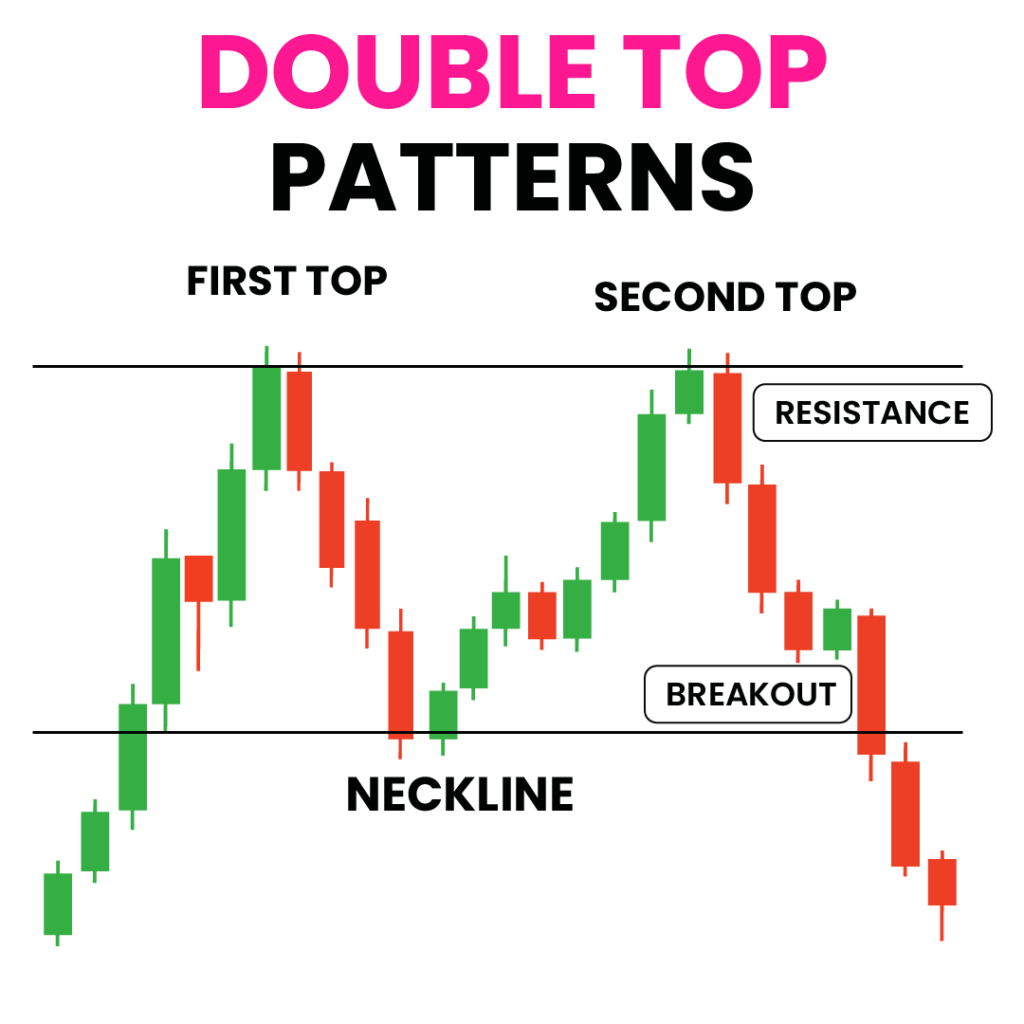
The double top pattern consists of two consecutive peaks at approximately the same price level, separated by a moderate trough. This formation typically emerges after an extended uptrend when the price fails to break through a resistance level on two separate attempts. The pattern completes when the price drops below the support level (neckline), connecting the two troughs between the peaks.

Is the double top pattern bullish? No, this pattern signals a bearish sentiment. It indicates that buyers failed twice to push prices above a specific resistance point, suggesting diminishing buying pressure and increasing selling interest. This failure to establish new highs often precedes a significant downward movement as sellers gain control of the market. The pattern reflects a shift in market psychology from optimism to caution and eventually to pessimism.

The rule for double top pattern identification requires two distinct peaks at approximately the same price level with a noticeable valley between them, followed by a break below the neckline support. Volume often decreases during the second peak and increases during the subsequent decline, confirming the pattern’s validity.

Difference Between Double Top and Double Bottom

While the double top indicates bearish reversals, the double bottom pattern represents its bullish counterpart. Double bottoms form after downtrends when prices make two unsuccessful attempts to break below a support level. This creates a “W” shape, signaling potential upward momentum. The psychology differs fundamentally — double tops reflect resistance to further upward movement, while double bottoms demonstrate support against continued decline.

Both patterns operate on similar principles of failed attempts to break significant price levels, but they predict opposite market directions. Traders often analyze these patterns together with other formations like the head and shoulders pattern or triangle chart pattern to confirm market sentiment shifts.

Identifying the Double Top Pattern

Accurate identification of the double top pattern requires attention to several key characteristics:

  • Visual Appearance: The pattern resembles the letter “M” on price charts, with two peaks reaching similar heights.
  • Price Levels: The two peaks should reach approximately the same price level, ideally within 3% of each other.
  • Timeframe: The formation typically develops over several weeks in longer timeframes, though it appears in shorter timeframes as well.
  • Volume Profile: Volume often decreases during the second peak compared to the first, indicating waning buying interest.
  • Neckline Confirmation: The pattern confirms when price breaks below the neckline — the support level connecting the trough between the peaks.

Avoid mistaking normal price fluctuations for genuine double top patterns. The peaks must represent significant resistance levels rather than minor price oscillations.

Formation of the Double Top Pattern

The double top pattern develops through three distinct phases. Initially, prices rise during an established uptrend, reflecting strong buying pressure and market optimism. This momentum carries the price to a new high before encountering resistance.

In the second phase, after reaching the initial peak, prices retrace as profit-taking occurs. This pullback typically ranges between 10% and 20% from the peak before buying interest returns. When prices rally again to approach the previous high, they encounter resistance at approximately the same level. The second failure to break through this ceiling demonstrates that buyers lack sufficient strength to establish new highs.

The final phase begins when prices fall from the second peak and break below the neckline support level. This breach confirms the pattern completion and signals the transition to a bearish trend. The psychology behind the double top pattern reflects changing market sentiment — initial optimism gives way to uncertainty after the first failure, then to pessimism after the second rejection.

What Happens After a Double Top Pattern?

Following a confirmed double top pattern, prices typically decline substantially. The statistical success rate of the double top pattern ranges between 65% and 70% in predicting meaningful downward movements. The expected price target often equals the distance from the peaks to the neckline, projected downward from the breakout point.

After the initial breakdown below the neckline, prices may temporarily retest this level from below, now acting as resistance rather than support. This retest provides an additional entry opportunity for traders who missed the initial breakdown.

Market volatility frequently increases during the post-pattern decline as more participants recognize the bearish reversal. Supporting technical indicators like the Relative Strength Index (RSI) or Moving Average Convergence Divergence (MACD) often confirm the downward momentum with bearish divergences or crossovers.

How To Trade a Double Top Pattern

Trading the double top pattern effectively requires a systematic approach:

Determining Strategic Entry Points: The safest entry occurs after confirmation, when prices close decisively below the neckline on increased volume. More aggressive traders may enter at the second peak if accompanied by bearish signals like divergences on momentum indicators. Additionally, the previously mentioned neckline retest offers another potential entry opportunity.

Setting Proper Exit Points: Calculate profit targets using the measured move technique — measure the vertical distance from peaks to neckline and project this distance below the breakout point. Implement a tiered profit-taking approach by closing portions of positions at different levels.

Implementing Stop-Loss Orders: Place stop-loss orders above the second peak to limit potential losses if the pattern fails. For more conservative risk management, position the stop-loss just above the neckline once prices break below it.

The bear flag pattern or bear pennant pattern may form during the decline following a double top, offering additional trading opportunities. Conversely, if prices unexpectedly move above the second peak, patterns like the cup and handle pattern or bull flag pattern might emerge instead.

Common Mistakes in Double Top Pattern Recognition

Several errors frequently undermine successful double top pattern trading:

  1. Premature Pattern Identification: Mistakes minor price fluctuations for completed double tops before the neckline breaks.
  2. Ignoring Volume Confirmation: Fails to verify declining volume at the second peak and increasing volume at the breakdown.
  3. Peak Height Discrepancy: Identifies patterns where the peaks differ significantly in height or occur too close together temporally.
  4. Neglecting Market Context: Trades the pattern in isolation without considering broader market conditions or prevailing trends.
  5. Overlooking Timeframe Analysis: Fails to check if the pattern appears across multiple timeframes for confirmation.

Confusing the double top with complex formations like the triple top pattern or mistaking a rising wedge pattern for a developing double top also leads to trading errors.

Trade the Double Top Pattern Effectively With Above the Green Line

Mastering the double top pattern provides a powerful tool for identifying potential market reversals and executing profitable trades. This pattern’s relatively high reliability, when correctly identified, makes it valuable for both novice and experienced traders.

For traders seeking to refine their technical analysis skills and develop comprehensive trading strategies incorporating patterns like the double top, Above the Green Line’s membership offers specialized resources, expert guidance, and advanced pattern recognition tools. These resources help you identify high-probability setups, determine optimal entry and exit points, and manage risk effectively across diverse market conditions.

By combining pattern recognition with disciplined trade management and proper risk assessment, traders maximize their potential for consistently profitable results when trading the double top pattern.


Related Articles

Double Top Patterns

Double Top Pattern: How to Identify and Trade This Reversal Signal

The double top pattern ranks as one of the trading patterns you should know when conducting technical analysis. This formation ...
Read More
Triple Bottom

What Is the Triple Bottom Pattern and How to Trade This Bullish Reversal?
Technical analysis provides you with powerful tools to identify potential market movements through pattern recognition. Among these valuable trading patterns ...
Read More
Average Return in Stock Market

What’s the Average Return in the Stock Market?

Investing in the stock market often raises the question: what is the average return one can expect? For most investors, ...
Read More
Triple Top Pattern

Triple Top Pattern: What It Is, How It Works, and Examples

The triple top pattern is one of the most reliable bearish reversal patterns in technical analysis. When properly identified, this ...
Read More
Triangle Chart Patterns

A Guide to the Triangle Chart Pattern in Technical Analysis

Triangle chart patterns represent distinct formations in price charts that technical analysts monitor to aid in making investment decisions. These ...
Read More
  • Previous
  • 1
  • 2
  • 3
  • 4
  • 5
  • 6
  • …
  • 15
  • Next
Loading...

April 2, 2025

What Is the Triple Bottom Pattern and How to Trade This Bullish Reversal?

Triple Bottom

By ATGL

Updated April 2, 2025

Technical analysis provides you with powerful tools to identify potential market movements through pattern recognition. Among these valuable trading patterns you should know, the triple bottom pattern stands out as a significant bullish reversal pattern. This pattern appears after a prolonged downtrend and signals a potential shift in market sentiment. Understanding how to identify and trade this pattern effectively can provide a strategic advantage in capturing profitable opportunities while minimizing potential losses.

What Is a Triple Bottom Pattern?

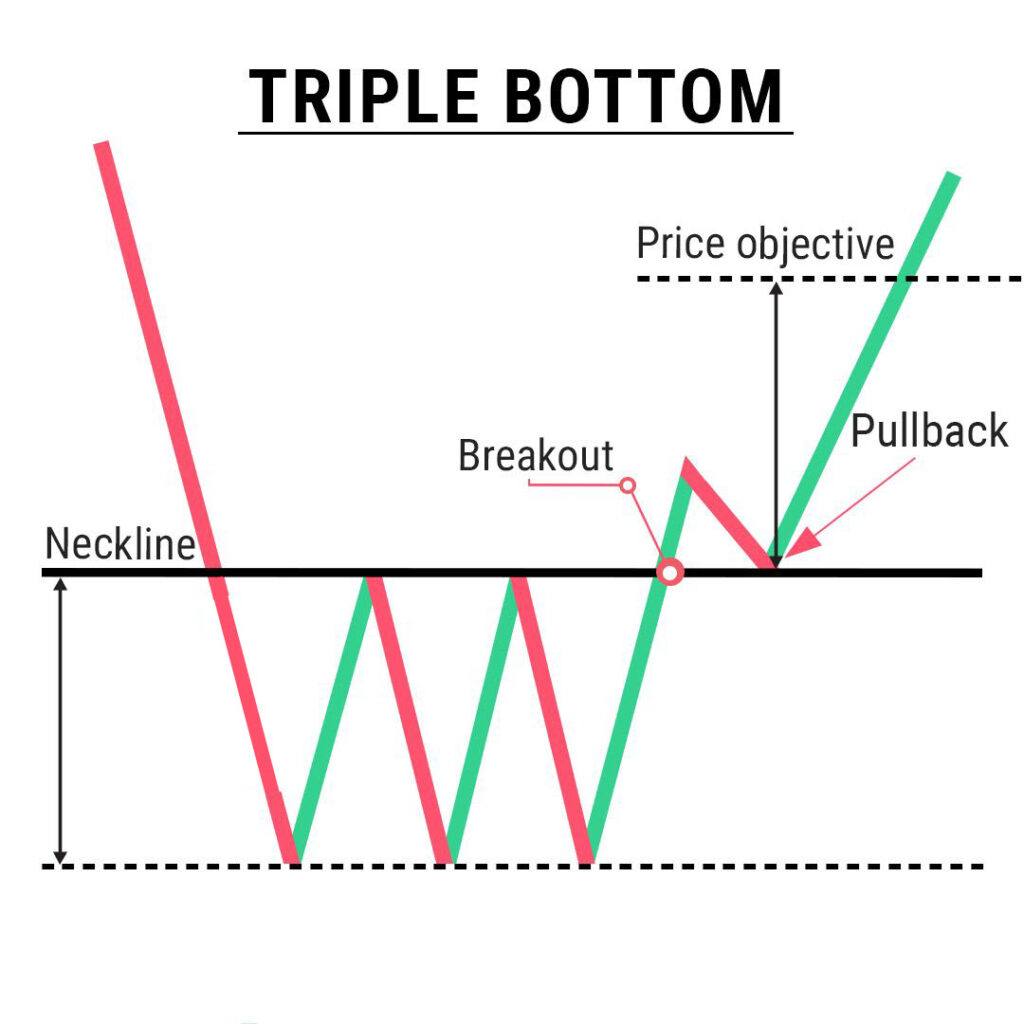
The triple bottom pattern is a bullish reversal pattern that forms after a prolonged downtrend, signaling potential trend reversals from bearish to bullish in the financial markets. As the name suggests, this pattern consists of three consecutive lows or “bottoms” that reach approximately the same price level, creating a horizontal support zone. The pattern demonstrates that sellers have attempted and failed three times to push prices below a critical resistance level, indicating weakening downward momentum and growing buyer interest.

Unlike the double bottom pattern, which only requires two tests of support, the triple bottom provides additional confirmation of support strength through its third test. This increased validation makes the triple bottom particularly noteworthy to technical analysts seeking high-probability trade setups. The completion of this pattern frequently precedes a substantial upward price movement as buyers gain dominance in the market.

Identifying the Triple Bottom Pattern

Recognizing a genuine triple bottom pattern requires attention to specific structural elements:

Three distinct lows: The pattern displays three troughs that reach approximately the same price level, typically within a 3% to 5% range of each other. These lows represent failed attempts by sellers to push prices lower.

Neckline resistance: A horizontal resistance level connects the peaks between the troughs. This neckline serves as a critical threshold; a decisive break above this level confirms the pattern.

Decreasing volume: Ideally, trading volume decreases during the formation of each successive bottom, indicating diminishing selling pressure. Volume should then increase significantly during the breakout above the neckline.

Time duration: Authentic triple bottoms develop over substantial time periods, typically several weeks to months. This extended duration contributes to the pattern’s reliability.

The triple bottom shares characteristics with other reversal patterns, like the head and shoulders pattern, but differs in its symmetrical structure. Unlike the rising wedge pattern, which forms during uptrends, the triple bottom specifically appears at the end of downtrends.

What Happens After Triple Bottom Pattern?

Trend reversal: Once the pattern is validated by a breakout above the neckline, the market sentiment shifts from bearish to bullish. This transition often leads to a sustained upward movement.

Price target projection: The measured move objective for the pattern equals the height of the formation (from support to neckline) added to the breakout point. This calculation provides you with reasonable profit targets.

Support conversion: The previous neckline resistance level frequently transforms into support when tested from above, offering potential entry opportunities on pullbacks.

Follow-through momentum: Successful breakouts generally demonstrate strong momentum, with prices advancing steadily after clearing the neckline. This momentum may accelerate as additional technical indicators confirm the reversal.

The triple bottom differs from continuation patterns like the bull flag pattern or bear pennant pattern, which signal temporary consolidations within existing trends rather than major potential trend reversals.

How To Trade a Triple Bottom Pattern

Optimal entry and exit points: The most reliable entry occurs after price breaks and closes above the neckline resistance on increased volume. Conservative traders may wait for a successful retest of the neckline as support before entering. Exit strategies should include a primary price target at the measured move objective, with partial position closing at significant resistance levels.

Using MACD for confirmation: The Moving Average Convergence Divergence (MACD) indicator offers valuable confirmation of the pattern’s validity. Bullish divergence between the MACD and price action during the formation of the third bottom strengthens the reversal signal. Additionally, a MACD line crossing above its signal line near the breakout point further validates the pattern.

Incorporating Fibonacci retracement: Fibonacci retracement levels help identify potential resistance zones during the subsequent uptrend. The 38.2%, 50%, and 61.8% retracement levels frequently align with natural pausing points in the price advance. These levels can serve as references for adding to positions or implementing trailing stops.

Like the triangle chart pattern and cup and handle pattern, proper risk management remains essential when trading the triple bottom. Setting stop-loss orders below the most recent bottom protects capital if the pattern fails.

Common Mistakes and Misinterpretations of a Triple Bottom Pattern

Entering positions prematurely: A common mistake involves initiating trades before pattern confirmation. True validation requires a decisive close above the neckline resistance. Premature entries often result in unnecessary potential losses during pattern formation.

Setting unrealistic profit targets: While triple bottoms can initiate substantial rallies, excessive profit expectations lead to missed opportunities. Adhering to the measured move calculation provides realistic objectives. Unlike the aggressive reversals seen with the bear flag pattern, triple bottom moves tend to be methodical rather than explosive.

Ignoring timeframe differences: Triple bottoms identified on lower timeframes generally prove less reliable than those on daily or weekly charts. Patterns that develop over extended periods demonstrate greater significance. Maintain awareness of the pattern’s context within multiple timeframes.

False signals: Market conditions can sometimes produce formations that resemble triple bottoms but lack the necessary validation criteria. These false signals often trap novice traders who fail to wait for proper confirmation before entering positions.

FAQs About Triple Bottom Pattern

Is a Triple Bottom Bullish or Bearish?

The triple bottom pattern is decidedly bullish, signaling potential trend reversals from a downtrend to an uptrend. After three unsuccessful attempts to breach support, buyers gain control and push prices higher.

What Is the Success Rate of the Triple Bottom Pattern?

Research indicates that properly formed triple bottom patterns have a success rate of approximately 75-80%. This reliability exceeds many other pattern types, though proper confirmation remains essential for optimal results.

What Is the Difference Between Double Bottom and Triple Bottom Patterns?

While both patterns signal bullish reversals, the triple bottom provides additional confirmation through its third test of support. This extra validation typically results in higher reliability but requires more time to develop compared to the double bottom formation.

Trade the Triple Bottom Pattern Effectively With Above the Green Line

Mastering the triple bottom pattern provides you with a key advantage in spotting high-probability reversal opportunities in various market conditions. Its clear structure makes it valuable in technical analysis. For best results, combine this pattern with other techniques, like the triple top pattern, to identify both bullish and bearish reversals.

Above the Green Line offers tools and resources to help you trade the triple bottom pattern effectively. Our analytical approach merges pattern recognition with advanced technical indicators to enhance your trading performance. Learn more about how we can help you leverage these powerful reversal signals.

Related Articles

Double Top Patterns

Double Top Pattern: How to Identify and Trade This Reversal Signal

The double top pattern ranks as one of the trading patterns you should know when conducting technical analysis. This formation ...
Read More
Triple Bottom

What Is the Triple Bottom Pattern and How to Trade This Bullish Reversal?

Technical analysis provides you with powerful tools to identify potential market movements through pattern recognition. Among these valuable trading patterns ...
Read More
Average Return in Stock Market

What’s the Average Return in the Stock Market?

Investing in the stock market often raises the question: what is the average return one can expect? For most investors, ...
Read More
Triple Top Pattern

Triple Top Pattern: What It Is, How It Works, and Examples

The triple top pattern is one of the most reliable bearish reversal patterns in technical analysis. When properly identified, this ...
Read More
Triangle Chart Patterns

A Guide to the Triangle Chart Pattern in Technical Analysis

Triangle chart patterns represent distinct formations in price charts that technical analysts monitor to aid in making investment decisions. These ...
Read More
  • Previous
  • 1
  • 2
  • 3
  • 4
  • 5
  • 6
  • …
  • 15
  • Next
Loading...

March 23, 2025

What’s the Average Return in the Stock Market?

Average Return in Stock Market

By ATGL

Updated March 23, 2025

Investing in the stock market often raises the question: what is the average return one can expect? For most investors, understanding stock market dynamics is crucial, as it helps set realistic expectations for financial growth. This article tackles these crucial topics by exploring historical data and the typical benchmarks used to measure stock returns.

The S&P 500 index is often considered the standard for gauging market performance due to its broad inclusion of large-cap companies in the U.S. economy. From average S&P 500 return by year to the difference between nominal and real returns, you’ll gain an understanding of stock market seasonality and how indices are calculated. Keep in mind that stock market indexes only provide a glimpse into a complex financial landscape.

Moreover, an array of factors, like inflation, greatly impacts returns, which is why long-term strategies such as diversification and reinvesting dividends are emphasized. We’ll also touch upon investment avenues like ETFs, index funds, and individual stocks, offering you insights into maximizing your returns while managing market timing and dynamics efficiently. Prepare to delve into the essentials for calculating stock returns and mastering investment strategies in the stock market.

Stock Market Average Return

The historical average return of the stock market is about 10% per year, mainly measured by the S&P 500 index, a prominent stock market index. However, yearly returns can swing dramatically due to market dynamics. From 2012 to 2021, the S&P 500 had an impressive average annual return of 14.8%, despite downturns like the 2020 bear market.

Here’s a look at various time periods and their average returns:

  • Last 10 years: 12.74%
  • Last 20 years: 8.14%
  • Last 30 years: 9.64%
  • Last 40 years: 11.6%

Calculating stock returns involves comparing the current and past stock prices adjusted for dividends. Inflation over time also affects returns, making long-term investing essential for buy-and-hold investors.

To invest, consider individual stocks, ETFs, or index funds. These options cater to different risk tolerances and investment goals. For instance, mutual funds offer diversification while exchange-traded funds come with lower expense ratios.

Understanding stock market seasonality can also aid in planning investments. Though historical averages offer guidance, they don’t guarantee future results, emphasizing the importance of a well-rounded investment portfolio.

Overview of the S&P 500 Returns

The S&P 500 is a key stock market index that tracks the performance of 500 large companies. It’s often used to measure the average stock market return.

S&P 500 Average Returns:

Time Period Average Annual Return
2018-2023 11.33%
2013-2023 12.39%
2003-2023 9.75%
1993-2023 9.90%
Since 1957 9.82%

From 2018 to 2023, the S&P 500 had a return of 11.33%, influenced by notable market dynamics. Over the past decade, the return was 12.39%, higher due to strong market performance. The 20-year return ending in 2023 was 9.75%, slightly below the long-term benchmark of 10%. Meanwhile, the 30-year average closely matched historical norms at 9.90%, showcasing resilience despite yearly fluctuations.

These returns help investors understand stock market averages over various time frames. While short-term market returns can be volatile due to stock market seasonality and other factors, the long-term perspective often provides a more stable view.

Average S&P 500 Return by Year

The average S&P 500 return varies over different time periods. From 2018 to mid-2023, the average annual return was 11.33%, but inflation-adjusted, it drops to 7.28%. For the 10-year span from 2013 to mid-2023, the S&P 500’s average return was 12.39%. After adjusting for inflation, it’s 9.48%. Over 20 years, from 2003 to mid-2023, the average return was 9.75%, with an inflation-adjusted return of 7.03%. In the last 30 years, the return averages 9.90%, or 7.22% with inflation.

Here’s a quick comparison:

  • 5-Year (2018-2023): 11.33% (7.28% inflation-adjusted)
  • 10-Year (2013-2023): 12.39% (9.48% inflation-adjusted)
  • 20-Year (2003-2023): 9.75% (7.03% inflation-adjusted)
  • 30-Year (1993-2023): 9.90% (7.22% inflation-adjusted)

Historically, the S&P 500 has averaged about 10.5% annually since 1957. As a long-term investment, the S&P 500 demonstrates solid growth, especially when considering inflation’s impact on real returns. Understanding the average S&P 500 return by year helps investors align their strategies with financial goals.

Nominal vs. Real Returns

When investing in the stock market, understanding nominal versus real returns is crucial.

  • Understanding Nominal Returns:
    • Nominal returns reflect the total earnings from an investment without accounting for inflation. The S&P 500’s nominal return over the past century has averaged around 10.06% annually. This figure shows substantial growth on paper.
  • Importance of Inflation-Adjusted Real Returns:
    • Real returns adjust for inflation, offering a clearer view of purchasing power growth. The long-term average real return of the S&P 500 stands at approximately 6.78%. While the nominal rate suggests higher gains, inflation can significantly erode buying power. The difference between nominal and real returns highlights that without considering inflation, the actual increase in wealth might be overstated.

This distinction between nominal and real returns is essential for understanding true investment growth. A table or list comparing these could simplify interpretation, but the key takeaway is the need to factor in inflation for a more accurate assessment of financial progress.

Factors Influencing Stock Market Returns

Factors that influence stock market returns are diverse and interconnected. One major factor is market volatility, which can arise due to sudden changes in investor sentiment. This can lead to unpredictable stock price fluctuations.

Economic growth also plays a crucial role. It drives corporate earnings, directly affecting stock returns. When economies grow, companies often perform better, buoying investor confidence.

Interest rates are another significant factor. Changes in rates influence borrowing costs and consumer spending. Lower interest rates can spur borrowing and spending, boosting stock prices.

Geopolitical events can disrupt markets, causing volatility. Wars, conflicts, and political shifts can affect global supply chains and energy costs, influencing investor outlooks.

Other important factors include national elections, which can alter policies and economic strategies. Supply chain disruptions also impact returns by affecting production costs and inventory levels, thus impacting company profitability.

In crafting an investment strategy, it’s crucial to consider these factors. Investors should weigh potential risks and opportunities to better navigate the ever-changing market dynamics.

Strategies for Maximizing Stock Market Returns

Maximizing stock market returns requires a thoughtful and disciplined approach. Investors often implement strategies like buy-and-hold, diversification, and reinvesting dividends to capitalize on the stock market’s average return. Understanding these strategies can lead to more consistent returns and help mitigate risks associated with market dynamics. Long-term investment perspectives and avoiding the temptation to time the market are crucial elements in achieving substantial stock market gains.

Benefits of Long-term Investing

Long-term investing is a cornerstone of successful stock market participation. Historically, the stock market has yielded around a 10% annual return, making it a reliable avenue for wealth creation over extended periods. By maintaining investments through market cycles, investors can benefit from compounding growth. This approach helps smooth out market volatility and supports a strategy where investors ride out short-term fluctuations. Diversified portfolios further cushion against severe market downturns, emphasizing stability and growth potential.

Dollar-Cost Averaging Explained

Dollar-cost averaging is a valuable strategy for mitigating market volatility risks. By investing a fixed amount at regular intervals, individuals avoid the pitfalls of investing large sums during market peaks. This method allows investors to accumulate shares at varying prices, often resulting in a lower average cost per share over time. As a result, dollar-cost averaging not only reduces investment risks but also promotes consistent buying of stocks, regardless of market conditions. Moreover, it helps investors maintain discipline and avoid panic selling.

Importance of Diversification

Diversification is crucial in managing investment risks. With stock market returns influenced by various unpredictable factors, a diversified portfolio balances higher and lower-risk investments. Stock market indexes, like the S&P 500, periodically rebalance to reflect changing economic landscapes, illustrating the need for diversification. Incorporating both stocks and bonds helps stabilize returns, as these asset classes often react differently to economic changes. This balance is especially important as the dominance of certain companies can significantly sway index performance.

Reinvesting Dividends

Reinvesting dividends is a powerful compounding strategy to enhance market returns. By automatically purchasing more shares with dividends, investors continuously increase their holdings. This not only builds investment portfolios but also leverages the benefits of fractional shares. Over time, reinvestment substantially boosts returns by allowing dividends to earn returns, known as compounding. Studies have shown that reinvested dividends contribute significantly to capturing long-term gains, accounting for a notable portion of total returns.

Avoiding Market Timing Errors

Avoiding market timing errors is essential to maximize stock market returns. Attempting to predict precise market highs or lows can lead to misguided investment decisions, affecting overall returns. Strategies like dollar-cost averaging mitigate this risk by ensuring consistent investments, regardless of market conditions. A buy-and-hold approach allows investors to capitalize on long-term growth potential, steering clear of timing pitfalls. Reacting to market volatility by hastily exiting investments could result in missed gains, underscoring the importance of a steady, disciplined investment approach.

Managing Your Investment Returns with Above the Green Line

Managing your investment returns can be streamlined with a company like Above the Green Line. The average stock market return is about 10% annually, as measured by the S&P 500. However, when adjusted for inflation, the real average return drops to around 6.37%. Diversifying your portfolio and reinvesting dividends can help maximize your returns through compounding.

A buy-and-hold approach supports long-term gains by weathering market volatility. Past events like the tech bubble and the Great Recession show how returns can dip below average, emphasizing the importance of a solid strategy. Here are some key strategies:

  • Diversify with mutual funds and ETFs
  • Opt for fractional shares to ease into investments
  • Work with financial advisors to manage risk tolerance

Incorporate these methods into your portfolio management to reach returns join Above the Green Line. Using stock market indexes, you can gauge performance and plan accordingly. Calculating stock returns involves assessing annual return data and understanding stock market seasonality which can influence performance. Keeping an eye on market dynamics and inflation over time is crucial for sustaining buying power. Investing wisely prepares you for a steady and profitable financial journey.

Related Articles

Double Top Patterns

Double Top Pattern: How to Identify and Trade This Reversal Signal

The double top pattern ranks as one of the trading patterns you should know when conducting technical analysis. This formation ...
Read More
Triple Bottom

What Is the Triple Bottom Pattern and How to Trade This Bullish Reversal?

Technical analysis provides you with powerful tools to identify potential market movements through pattern recognition. Among these valuable trading patterns ...
Read More
Average Return in Stock Market

What’s the Average Return in the Stock Market?

Investing in the stock market often raises the question: what is the average return one can expect? For most investors, ...
Read More
Triple Top Pattern

Triple Top Pattern: What It Is, How It Works, and Examples

The triple top pattern is one of the most reliable bearish reversal patterns in technical analysis. When properly identified, this ...
Read More
Triangle Chart Patterns

A Guide to the Triangle Chart Pattern in Technical Analysis

Triangle chart patterns represent distinct formations in price charts that technical analysts monitor to aid in making investment decisions. These ...
Read More
  • Previous
  • 1
  • 2
  • 3
  • 4
  • 5
  • 6
  • …
  • 15
  • Next
Loading...

February 28, 2025

Triple Top Pattern: What It Is, How It Works, and Examples

Triple Top Pattern

By ATGL

Updated February 28, 2025


The triple top pattern is one of the most reliable bearish reversal patterns in technical analysis. When properly identified, this formation can give you valuable insight into potential market direction changes and profitable trading opportunities.

What Is a Triple Top Pattern?

A triple top pattern is a technical chart formation that indicates a potential reversal from an uptrend to a downtrend. It consists of three distinct peaks at approximately the same price level, with moderate pullbacks between them. This pattern signals that despite multiple attempts, buyers cannot push the price beyond a specific resistance level, suggesting weakening bullish momentum and increasing bearish pressure.

The triple top is considered complete when the price breaks below the “neckline” — the support level formed by the troughs between the peaks. This confirmation signals that sellers have gained control and a new downtrend may be underway.

Technical analysts view the triple top as a powerful signal that an asset’s upward momentum has exhausted, providing you with a strategic opportunity to enter short positions or exit existing long positions.

Key Components of the Triple Top Pattern

Understanding the essential elements of a triple top pattern helps you identify genuine reversal signals and avoid false patterns.

The Three Peaks

The most distinctive feature of the triple top pattern is the three consecutive peaks that reach approximately the same price level. These peaks represent repeated failed attempts by buyers to push the price higher, demonstrating a clear resistance level. While the peaks don’t need to be exactly equal in height, they should be relatively close, typically within 1-2% of each other.

The Resistance Level

The horizontal line connecting the three peaks forms a significant resistance level. This price zone represents the point where selling pressure consistently overcomes buying pressure. Each time the price approaches this level, more sellers enter the market, preventing further upward movement.

Volume Considerations

Volume trends provide important confirmation for triple top patterns. Ideally, volume should decrease during the formation of the second and third peaks, indicating waning buying interest. Conversely, volume should increase significantly during the breakdown below the neckline, confirming strong selling pressure and pattern validity.

How the Triple Top Chart Pattern Forms

The triple top pattern typically develops after a sustained uptrend and follows a predictable sequence:

  1. Initial Peak: After a prolonged uptrend, the price reaches a new high but meets resistance and pulls back.
  2. Second Peak: Buyers attempt to resume the uptrend, pushing the price back toward the previous high. However, once again, they fail to break through the resistance, causing another pullback.
  3. Third Peak: In a final effort, bulls push the price to the resistance level one more time. The failure to break through for a third time strongly suggests that the uptrend has been exhausted.
  4. Neckline Break: The pattern is confirmed when the price falls below the support level (neckline) formed by the troughs between the peaks. This breakdown, especially when accompanied by high volume, signals that sellers have taken control.

This pattern represents the transition from a market dominated by buyers to one controlled by sellers, making it an important formation for identifying trends in stock charts.

Identifying the Triple Top Pattern

Accurately identifying a genuine triple top pattern requires attention to specific market conditions and timing considerations.

Recognizing Market Conditions

Triple tops typically form after sustained uptrends when buying momentum begins to wane. The pattern is more reliable when it appears at key resistance levels, such as previous historical highs or major psychological price points. You should also consider the broader market context — triple tops tend to be more reliable during market transitions or when fundamentals suggest potential trend changes.

Timing Entry Points

The most conservative entry strategy is to wait for confirmation of the pattern — specifically, a decisive break below the neckline with increased volume. Some traders use additional confirmation signals, such as a failed retest of the neckline from below or bearish candlestick patterns forming at the third peak.

It’s essential to distinguish the triple top from consolidation patterns or temporary pauses in an uptrend. False signals can be reduced by waiting for clear neckline breaks and using multiple timeframes to confirm the pattern development.

Trading Strategies for the Triple Top Pattern

Once identified, the triple top pattern offers several strategic approaches for traders.

Profit Targeting Methods

A common approach to setting price targets uses the height of the pattern. Measure the vertical distance from the resistance level (tops) to the support level (neckline), then project this distance downward from the neckline breakpoint. This measurement provides a minimum price objective for the downward move.

Alternatively, you can use Fibonacci retracement levels to identify potential support zones where the price might pause or reverse during its decline.

Stop-Loss Placement Techniques

Risk management is important when trading the triple top pattern. Conservative traders typically place stop-loss orders slightly above the third peak to protect against false breakdowns. More aggressive traders might place stops just above the neckline after it has been broken, allowing for potential retests while minimizing risk.

Position sizing should be determined based on the distance to the stop-loss, ensuring that potential losses remain within acceptable risk parameters. Like other trading patterns, the triple top requires disciplined execution of both entry and exit strategies.

Comparing Triple Top and Triple Bottom Patterns

The triple top pattern has a bullish counterpart — the triple bottom pattern. While the triple top forms at market highs and signals potential downtrends, the triple bottom appears at market lows and indicates possible uptrends. Both patterns reflect the market’s struggle at key price levels and the eventual victory of either buyers or sellers.

The trading approach for triple bottoms mirrors that of triple tops, with the direction reversed. Triple bottoms are confirmed when the price breaks above the “neckline” resistance, with targets projected upward based on the pattern’s height.

Understanding both patterns enhances your ability to identify potential reversals in different market conditions. These formations share similarities with other patterns, like the Bear Pennant trading pattern, in terms of their significance for trend analysis.

Real-World Example of Triple Top Patterns

Traders have successfully used the triple top pattern to anticipate market reversals. For instance, in 2016, gold prices formed a triple top around Rs. 1350-Rs. 1375 but failed to break resistance. Once support at Rs. 1250 was breached, prices dropped significantly, allowing traders to profit from short positions.

The triple top pattern can provide valuable trading signals when properly identified and confirmed. By studying historical examples, you can improve their pattern recognition skills and better understand the behavioral dynamics that create these formations.

Utilizing the Triple Top in Market Analysis

The triple top pattern is most effective when used as part of a comprehensive trading strategy. Rather than relying solely on this pattern, experienced traders incorporate additional technical indicators such as RSI, MACD, or moving averages to confirm the reversal signal. This multi-faceted approach to drawing stock charts and analysis helps filter out false signals and improves trading outcomes.

Market context also matters significantly. Triple tops forming in securities with deteriorating fundamentals or in sectors experiencing broader weakness tend to be more reliable. Similarly, the pattern’s appearance at key resistance levels or during periods of increasing market volatility often enhances its predictive value.

Take your trading to the next level with our comprehensive trading courses and community support. Join Above The Green Line today and gain access to expert insights, real-time trading discussions, and advanced technical analysis training that will transform your approach to the markets. Become a member now and start your journey toward more consistent trading success.

Related Articles

Double Top Patterns

Double Top Pattern: How to Identify and Trade This Reversal Signal

The double top pattern ranks as one of the trading patterns you should know when conducting technical analysis. This formation ...
Read More
Triple Bottom

What Is the Triple Bottom Pattern and How to Trade This Bullish Reversal?

Technical analysis provides you with powerful tools to identify potential market movements through pattern recognition. Among these valuable trading patterns ...
Read More
Average Return in Stock Market

What’s the Average Return in the Stock Market?

Investing in the stock market often raises the question: what is the average return one can expect? For most investors, ...
Read More
Triple Top Pattern

Triple Top Pattern: What It Is, How It Works, and Examples

The triple top pattern is one of the most reliable bearish reversal patterns in technical analysis. When properly identified, this ...
Read More
Triangle Chart Patterns

A Guide to the Triangle Chart Pattern in Technical Analysis

Triangle chart patterns represent distinct formations in price charts that technical analysts monitor to aid in making investment decisions. These ...
Read More
  • Previous
  • 1
  • 2
  • 3
  • 4
  • 5
  • 6
  • …
  • 15
  • Next
Loading...

February 28, 2025

A Guide to the Triangle Chart Pattern in Technical Analysis

Triangle Chart Patterns

By ATGL

Updated February 28, 2025

Triangle chart patterns represent distinct formations in price charts that technical analysts monitor to aid in making investment decisions. These patterns emerge through the compression of price movements, forming triangular shapes on charts. By analyzing these patterns, you can anticipate potential price movements and develop appropriate trading strategies.

Understanding Triangle Chart Patterns

Triangle patterns form when price fluctuations gradually narrow over time, creating a triangular shape on the chart. These patterns typically manifest during consolidation phases, where market indecision leads to decreasing volatility before a significant price movement occurs. The duration of triangle formations varies from several weeks to months, with the pattern becoming more reliable as it develops.

The core characteristic of triangle patterns involves the convergence of support and resistance levels. As buyers and sellers reach equilibrium, trading ranges contract, leading to decreased volatility. This contraction often precedes a breakout, where prices move decisively beyond the pattern’s boundaries.

Unlike other trading patterns, triangles provide valuable insights into both price targets and the potential timing of breakouts. The height of the triangle at its widest point offers a measurement for projecting price objectives following a breakout.

Types of Triangle Patterns

Technical analysis recognizes three primary triangle patterns, each with distinct characteristics and implications for future price movements.

Ascending Triangle Chart Pattern

The ascending triangle chart pattern features a horizontal resistance line at the top and an upward-sloping support line at the bottom. This pattern indicates bullish sentiment, with buyers consistently willing to purchase at higher prices while sellers maintain a consistent resistance level.

Key characteristics of ascending triangles include:

  • A flat upper trendline representing consistent resistance
  • An upward-sloping lower trendline showing increasing support levels
  • Decreasing volume as the pattern develops
  • Typically, bullish implications, particularly in uptrends

Ascending triangles generally signal continuation in an uptrend, though they occasionally form reversal patterns during downtrends. The pattern completes when price breaks through the upper resistance line, often accompanied by increased trading volume.

Descending Triangle Chart Pattern

The descending triangle chart pattern displays a horizontal support line at the bottom and a downward-sloping resistance line at the top. This formation suggests bearish market sentiment, with sellers accepting progressively lower prices while buyers maintain support at a fixed level.

Distinguishing features of descending triangles include:

  • A flat lower trendline representing consistent support
  • A downward-sloping upper trendline showing decreasing resistance levels
  • Gradually declining volume within the pattern
  • Predominantly bearish implications, especially in downtrends

Similar to the Bear Pennant trading pattern, descending triangles typically forecast continuation in a downtrend. The pattern completes when price breaks below the support line, often with a notable increase in trading volume.

Symmetrical Triangle Chart Pattern

The symmetrical triangle chart pattern presents converging trendlines, with the upper line sloping downward and the lower line sloping upward. This pattern indicates market indecision, with neither buyers nor sellers gaining a decisive advantage.

Notable characteristics of symmetrical triangles include:

  • Converging upper and lower trendlines with roughly equal slopes
  • Decreasing volume as the pattern progresses
  • Neutral bias until breakout direction becomes apparent
  • Tendency to function as continuation patterns in existing trends

The direction of the breakout from a symmetrical triangle often aligns with the prevailing trend, though exceptions occur. Wait for a clear breakout before establishing positions.

Identifying Triangle Patterns on Charts

Accurate identification of triangle patterns requires methodical identifying trends in stock charts and precise drawing stock charts techniques. When analyzing potential triangle patterns, consider these guidelines:

First, identify at least two points for each trendline. For the upper trendline, connect at least two significant highs; for the lower trendline, connect at least two significant lows. The pattern becomes more reliable when more points align with these trendlines.

Second, confirm the convergence of trendlines. In valid triangle patterns, trendlines should converge toward a future point, creating the characteristic triangular shape.

Third, monitor trading volume. Volume typically decreases as the triangle pattern develops, often reaching its lowest levels near the apex before expanding significantly during breakouts.

Fourth, assess pattern maturity. The most reliable triangle patterns develop over extended periods and complete between 50-75% of the way to the apex. Patterns that reach the apex without breaking out frequently lead to weaker subsequent movements.

Signals Indicating Continuation vs. Reversal

While triangles primarily function as continuation patterns, they occasionally signal reversals. Distinguishing between continuation and reversal scenarios improves trading success rates.

For continuation signals, examine the prevailing trend before the triangle forms. Triangles appearing mid-trend more likely indicate continuation. Additionally, ensure the pattern respects trendlines without significant violations. Lastly, analyze volume patterns for gradual decline within the formation followed by expansion during breakouts.

For potential reversals, watch for triangles forming after extended trends, particularly with diminishing momentum. Monitor oscillators for divergence between price and indicators, which may signal reversal potential. Also, note breakouts contrary to the prevailing trend, especially with strong volume confirmation.

Trading Strategies for Triangle Patterns

Effective triangle pattern trading requires systematic approaches tailored to each pattern type.

For ascending triangles, enter long positions when price breaks above the horizontal resistance with increased volume. Set stop-loss orders slightly below the most recent swing low within the pattern. Target profits by measuring the height of the triangle at its widest point and projecting that distance upward from the breakout point.

For descending triangles, enter short positions when price breaks below horizontal support with increased volume. Place stop-loss orders slightly above the most recent swing high within the pattern. Project profit targets by measuring the pattern’s height and extending that distance downward from the breakout point.

For symmetrical triangles, wait for a confirmed breakout in either direction before establishing positions. Entry points should occur when price closes beyond the trendline with increased volume. Set stop-loss orders at the opposite trendline or recent swing high/low. Calculate profit targets using the pattern’s height projected from the breakout point.

Impact of Economic News on Triangle Breakouts

Economic announcements and news events significantly influence triangle pattern breakouts. Major economic reports, corporate earnings announcements, and central bank decisions often trigger breakouts from established patterns.

You should maintain awareness of scheduled economic events when trading triangle patterns. False breakouts frequently occur before significant announcements, followed by decisive moves afterward. Consider postponing entries until after major news events to avoid false signals.

Volume analysis becomes particularly important around economic announcements. Genuine breakouts typically display strong volume confirmation, while false moves often lack robust volume support.

Integrating Technical Indicators with Triangle Patterns

Combining triangle patterns with technical indicators enhances trading precision. Momentum indicators like the Relative Strength Index (RSI) and Moving Average Convergence Divergence (MACD) help confirm breakout validity.

When RSI diverges from price within triangle patterns, potential trend exhaustion may occur. Similarly, MACD histogram expansion during breakouts supports genuine moves rather than false breakouts.

Moving averages provide additional context for triangle patterns. Breakouts occurring above key moving averages in ascending triangles reinforce bullish signals, while breakouts below important moving averages in descending triangles strengthen bearish indications.

Succeeding in the Stock Market

Mastering triangle chart patterns provides a significant advantage for technical analysts and traders. These formations offer valuable insights into market psychology and potential price movements when correctly identified and interpreted.

To maximize your trading success with triangle patterns and other technical analysis tools, consider exploring Above the Green Line’s comprehensive educational resources and trading services. Our expert analysis and specialized tools can help you identify profitable opportunities across various market conditions.

For personalized guidance and advanced trading strategies tailored to your investment goals, explore our membership options today. Our professional team provides the knowledge and support necessary to navigate complex market environments with confidence.

Related Articles

Double Top Patterns

Double Top Pattern: How to Identify and Trade This Reversal Signal

The double top pattern ranks as one of the trading patterns you should know when conducting technical analysis. This formation ...
Read More
Triple Bottom

What Is the Triple Bottom Pattern and How to Trade This Bullish Reversal?

Technical analysis provides you with powerful tools to identify potential market movements through pattern recognition. Among these valuable trading patterns ...
Read More
Average Return in Stock Market

What’s the Average Return in the Stock Market?

Investing in the stock market often raises the question: what is the average return one can expect? For most investors, ...
Read More
Triple Top Pattern

Triple Top Pattern: What It Is, How It Works, and Examples

The triple top pattern is one of the most reliable bearish reversal patterns in technical analysis. When properly identified, this ...
Read More
Triangle Chart Patterns

A Guide to the Triangle Chart Pattern in Technical Analysis

Triangle chart patterns represent distinct formations in price charts that technical analysts monitor to aid in making investment decisions. These ...
Read More
  • Previous
  • 1
  • 2
  • 3
  • 4
  • 5
  • 6
  • …
  • 15
  • Next
Loading...
  • « Previous Page
  • 1
  • 2
  • 3
  • 4
  • 5
  • 6
  • …
  • 15
  • Next Page »

Subscribe to Our Newsletter

AGL Logo

Get our eBook Now!

Candlestick - A Swing Traders Friend

We don’t spam! Read our privacy policy for more info.

Check your inbox or spam folder to confirm your subscription.

Voted #1 at Stock Charts

SH Chart
Inverse S&P 500 Fund (SH) will have a Money Wave Buy today.

Help Us Help Animals

Help Us Help Animals

Recent Comments

  • AbovetheGreenLine on Green Line Weekly Aug 27, 2023
  • lbrodt on Green Line Weekly Aug 27, 2023
  • Mitch Van Zelfden on Money Wave Alert! Jul 31, 2023
  • AbovetheGreenLine on Money Wave Alert! Jul 31, 2023
  • Mitch Van Zelfden on Money Wave Alert! Jul 31, 2023

Become a Green Liner!

Help me make more Money in the Stock Market.

Investing with Rules.

On ATGL

  • DashBoard
  • Weekly Commentary
  • Daily Buy / Sell Signals
  • Day Trade Setup
  • Trading Rooms

Strategies

  • Swing Trading
  • ATGL Pick of the Week
  • Dividend Growth
  • ETF Sector Rotation
  • Dogs of the Dow

Help

  • ATGL Trading Rules
  • FAQ
  • Account Maintenance
  • Contact US
  • Join

Stay Updated

No credit card required. Unsubscribe anytime

Check your inbox or spam folder to confirm your subscription.

© 2024 Above The Green Line. All rights reserved.

  • Twitter
  • LinkedIn
  • YouTube