• Market Insights
        • Commentary
          • Daily
          • Weekly
        • BUY / SELL SIGNALS
          • Trade Posts
          • Recent Trade Alerts
          • Recent Day Trades
        • BLOGROLL
          • Dividend Growth Blog
          • ETF Sector Blog
          • Dow Dogs
          • TPOW Blog
  • Strategies
        • SWING TRADING
          • Current Positions
          • Watchlists
          • Closed Positions
          • Candidates - TOP 100
          • Specialty Stocks
        • WEEKLY STOCK PICK
          • TPOW Charts
          • TPOW Performance
          • TPOW Strategy Guide
          • TPOW Performance Dashboard
        • DAY TRADING
          • Watch List
        • ATGL DASHBOARD
        • ETF STRATEGIES
          • ETF Sector Rotation
          • ETF Sector Portfolio
        • DIVIDEND GROWTH
          • Dividend Growth Portfolio
          • Dividend Calendar
        • DOGS OF THE DOW
          • Dogs of the Dow Portfolio
          • DOW 5 Portfolio
  • Markets
        • US MARKET
          • Commodities
          • Energy
          • Precious Metals
          • Volatility
        • GLOBAL MARKETS
          • Market Indices
          • Economic Calendar
          • FOREX Heat Map
          • FOREX Cross Rates
          • Crypto Currency Market
  • Investing
    • Discord Community
    • Dashboard
  • Resources
        • ARTICLES
          • Dividend Growth Model Articles
          • ETF Articles
          • Investment Strategies Articles
          • Market and Economic Insights
          • Stock Trade Articles
          • Stock Reviews
        • TOOLS
          • Stock Scanners
          • Charting Software
          • Brokerage Firms
        • STOCK CHARTS
          • Key Components
          • Reading Charts
          • Drawing Stock Charts
          • Identifying Trends
        • RETIREMENT PLANNING
  • About
    • Contact Us
    • How to Win
    • #1 At Stockcharts
    • Disclaimer
    • FAQ
  • Log In
  • Subscribe
Menu
  • Market Insights
    • Commentary
      • Daily
      • Weekly
    • BUY / SELL SIGNALS
      • Trade Posts
      • Recent Trade Alerts
      • Recent Day Trades
    • BLOGROLL
      • Dividend Growth Blog
      • ETF Sector Blog
      • Dow Dogs
      • TPOW Blog
  • Strategies
    • SWING TRADING
      • Current Positions
      • Watchlists
      • Closed Positions
      • Candidates – TOP 100
      • Specialty Stocks
    • DAY TRADING
      • Watch List
    • WEEKLY STOCK PICK
      • TPOW Charts
      • TPOW Performance
      • TPOW Strategy Guide
      • TPOW Performance Dashboard
    • DIVIDEND GROWTH
      • Dividend Growth Portfolio
      • Dividend Calendar
    • DOGS OF THE DOW
      • Dogs of the Dow Portfolio
      • DOW 5 Portfolio
    • ETF STRATEGIES
      • ETF Sector Rotation
      • ETF Sector Portfolio
    • ATGL DASHBOARD
  • Markets
    • US MARKET
      • Commodities
      • Energy
      • Precious Metals
      • Volatility
    • GLOBAL MARKETS
      • Market Indices
      • Economic Calendar
      • FOREX Heat Map
      • FOREX Cross Rates
      • Crypto Currency Market
  • Investing
    • Discord Community
    • Dashboard
  • Resources
    • ARTICLES
      • Dividend Growth Model Articles
      • ETF Articles
      • Investment Strategies Articles
      • Market and Economic Insights
      • Stock Trade Articles
      • Stock Reviews
    • TOOLS
      • Stock Scanners
      • Charting Software
      • Brokerage Firms
    • STOCK CHARTS
      • Key Components
      • Reading Charts
      • Drawing Stock Charts
      • Identifying Trends
    • RETIREMENT PLANNING
  • About
    • Contact Us
    • How to Win
    • #1 At Stockcharts
    • Disclaimer
    • FAQ
  • Log Out
    • Members-Page
    • Referral
  • Log In
  • Subscribe
Log In
Log Out
Subscribe

May 1, 2025

MACD Indicator: How To Use Moving Average Convergence Divergence in Trading
MACD Indicator

By ATGL

Updated May 7, 2025

The Moving Average Convergence Divergence (MACD) indicator is one of the most widely used technical analysis tools available to traders. This momentum oscillator tracks the relationship between two moving averages of a security’s price, helping you identify potential trend changes and momentum shifts. Understanding how to interpret and apply MACD signals effectively can significantly enhance trading strategies across various markets and timeframes.

Understanding Moving Averages

Moving averages calculate the average price of a security over a specified time period, creating a smoothed line that filters out short-term price fluctuations. These technical tools help you identify trends by averaging prices over time. Two common types are Simple Moving Averages (SMA), which weigh all prices equally, and Exponential Moving Averages (EMA), which assign greater weight to recent prices. The MACD utilizes these EMAs to generate its signals.

What Is the MACD Indicator?

The MACD indicator functions as a momentum oscillator that detects changes in the strength, direction, momentum, and duration of price trends. Developed by Gerald Appel in the late 1970s, this trading indicator calculates the mathematical relationship between two exponential moving averages.

The standard MACD calculation subtracts the 26-period EMA from the 12-period EMA. The formula is expressed as:

MACD Line = 12-period EMA – 26-period EMA

This calculation produces the main MACD line, which oscillates above and below a zero line. Additionally, a 9-period EMA of the MACD line itself creates the “signal line,” which serves as a trigger for buy and sell signals.

Signal Line = 9-period EMA of MACD Line

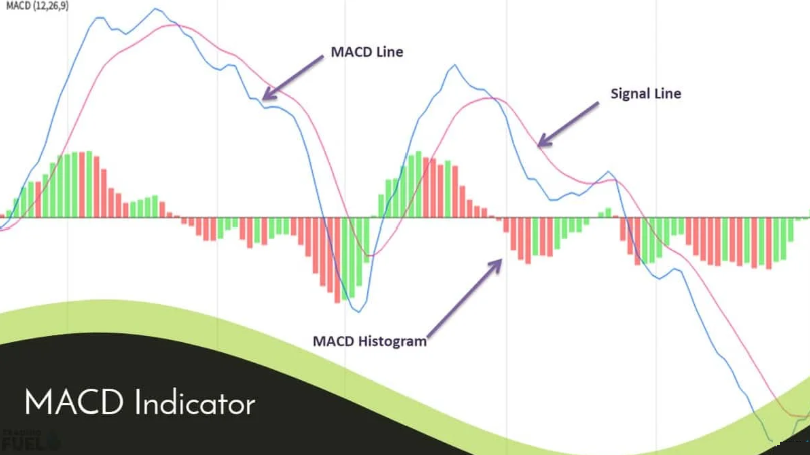
The difference between the MACD line and the signal line forms the histogram, visually representing the distance between these two lines.

How To Read a MACD Indicator

The MACD indicator consists of three primary components that traders analyze to make investment decisions:

  1. MACD Line: This main line reflects the difference between the short-term and long-term EMAs (typically 12 and 26 periods), measuring momentum shifts in the price.
  2. Signal Line: This secondary line represents the 9-period EMA of the MACD line itself, functioning as a trigger mechanism for buy and sell signals.
  3. Histogram: This bar chart depicts the distance between the MACD line and the signal line. When the MACD line crosses above the signal line, the histogram becomes positive. When it crosses below, the histogram turns negative.

The use of MACD on stock charts typically displays these components together, with the MACD and signal lines appearing as overlapping curves and the histogram as vertical bars. The positioning of these elements relative to the zero line and each other generates various trading signals.

What Are the Key Signals of the MACD Indicator?

The MACD generates several distinct signals that you can use to identify potential market entries and exits.

Crossover Signals

  • Signal Line Crossover: When the MACD line crosses above the signal line, it generates a bullish signal; conversely, a crossover below the signal line indicates a bearish signal.
  • Zero Line Crossover: When the MACD line moves above the zero line, it suggests bullish momentum; when it falls below, it indicates bearish momentum.
  • Dual MACD Crossover: This strategy involves monitoring both types of crossovers simultaneously for stronger confirmation.

Divergence Signals

  • Regular Divergence: Occurs when the price creates new highs or lows, but the MACD fails to confirm these extremes, potentially signaling a reversal.
  • Hidden Divergence: Appears when the price makes a higher low in an uptrend or a lower high in a downtrend, while the MACD makes a lower low or higher high, respectively, often indicating continuation.
  • Exaggerated Divergence: Presents when the divergence becomes particularly pronounced, potentially signaling a stronger reversal.

Traders who trade RSI-MACD divergence often find these signals particularly powerful when confirmed by multiple indicators.

How To Use the MACD Indicator

Employing the MACD involves several practical strategies.

Entry and Exit Signals

  • Enter long positions when the MACD line crosses above the signal line, especially if this occurs below the zero line (indicating a potential shift from bearish to bullish).
  • Exit long positions or enter short positions when the MACD line crosses below the signal line, particularly if this happens above the zero line.
  • Utilize divergences as early warning signs of potential trend reversals.

Multiple Timeframe Analysis

  • Apply the MACD across different timeframes to confirm signals.
  • Look for alignment of MACD signals on higher and lower timeframes to strengthen confidence in trade decisions.
  • Use longer timeframes for trend direction and shorter timeframes for entry timing.

Combining MACD With Other Indicators

  • Pair the MACD with trend-following indicators like moving averages to validate the underlying trend.
  • Combine with oscillators such as the Relative Strength Index (RSI) to confirm overbought or oversold conditions.
  • Integrate with volume indicators to verify the strength behind MACD signals.

Benefits and Limitations of MACD

Benefits

  • The MACD effectively identifies momentum shifts in various market conditions.
  • Its visual presentation makes trend changes relatively straightforward to interpret.
  • The indicator works across multiple timeframes and financial instruments.
  • The MACD provides both trend and momentum information in a single indicator.

Limitations

  • Like all oscillators, the MACD can generate false signals, particularly in sideways or choppy markets.
  • The standard settings may not be optimal for all securities or timeframes, requiring adjustment.
  • The MACD operates with a lag, as it relies on moving averages, potentially delaying entry or exit signals.
  • During strong trends, the indicator may remain in overbought or oversold territory for extended periods.

Implementing MACD In Your Investment Strategy

Integrating the MACD indicator into your trading approach requires methodical testing and adaptation. Begin by applying the standard settings (12, 26, 9) to historical data of your preferred securities, noting how accurately the signals would have predicted actual price movements. Gradually adjust these parameters to potentially enhance performance for specific assets or timeframes.

Focus on establishing clear rules for entries, exits, and risk management based on MACD signals. Consider allocating only a portion of your portfolio to MACD-based strategies initially, increasing this allocation as you confirm effectiveness. Document and analyze both successful and unsuccessful trades to refine your implementation.

For traders seeking comprehensive technical analysis systems that incorporate the MACD alongside other powerful indicators, Above the Green Line offers specialized memberships designed to optimize your trading performance. These professional resources provide structured frameworks for implementing momentum-based strategies across various market conditions, helping you transform technical signals into actionable trading plans. Explore our membership options and enhance your trading strategy today.


Related Articles

MACD Indicator

MACD Indicator: How To Use Moving Average Convergence Divergence in Trading

The Moving Average Convergence Divergence (MACD) indicator is one of the most widely used technical analysis tools available to traders ...
Read More
Fibonacci Retracement

Fibonacci Retracement: How To Use It for Support, Resistance, and Trade Entries
Knowing how to identify key price levels is critical in any successful trading methodology. Among the most relied-upon tools for ...
Read More
Bollinger Bands

Bollinger Bands: How to Trade Volatility and Spot Breakout Opportunities
Bollinger Bands represent one of the most versatile tools in technical analysis, providing traders with important information about price volatility ...
Read More
Rounding Bottom Pattern

Rounding Bottom Pattern: How to Trade This Gradual Bullish Reversal
In trading, the rounding bottom pattern represents a significant bullish reversal formation that develops gradually over extended periods. This pattern ...
Read More
Rectangle Pattern in Trading

Rectangle Pattern in Trading: How To Identify and Profit from Price Consolidation
In technical analysis, price action often moves in identifiable patterns. Among the most common and reliable is the rectangle pattern ...
Read More
  • 1
  • 2
  • 3
  • …
  • 15
  • Next
Loading...

May 1, 2025

Fibonacci Retracement: How To Use It for Support, Resistance, and Trade Entries

Fibonacci Retracement

By ATGL

Updated May 1, 2025

Knowing how to identify key price levels is critical in any successful trading methodology. Among the most relied-upon tools for this purpose is the Fibonacci retracement—a technical indicator that helps traders locate potential reversal levels in financial markets. Whether an investor is new to the concept or refining their current strategy, mastering Fibonacci retracement will significantly enhance their ability to pinpoint support, resistance, and optimal trade entries. It is especially effective when used to identify resistance levels that align with broader market patterns.

What Is Fibonacci Retracement?

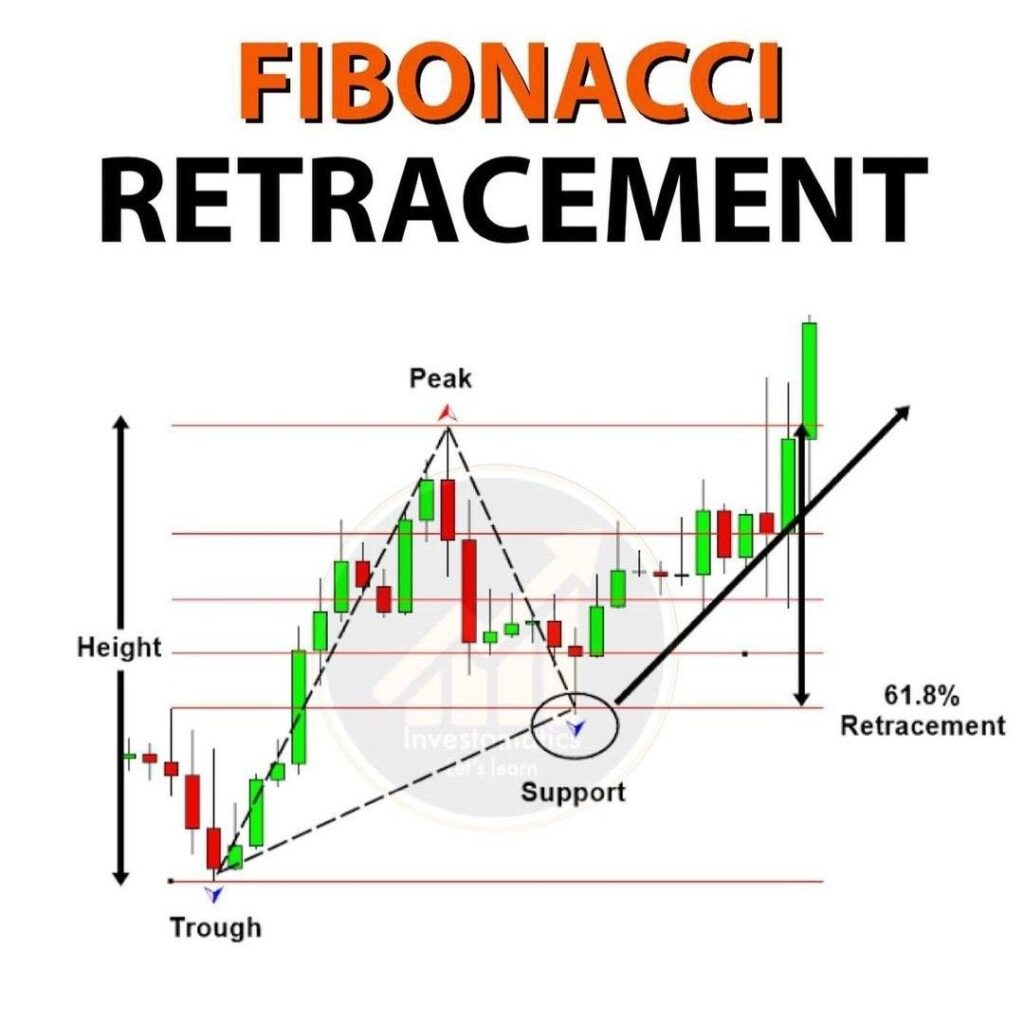
Fibonacci retracement is a technical indicator based on the Fibonacci sequence, which is a series of numbers where each is the sum of the two preceding ones (e.g., 0, 1, 1, 2, 3, 5, 8, 13, etc.). Derived from this sequence are ratios that can help identify price movements, particularly 23.6%, 38.2%, 50%, 61.8%, and 78.6%. These ratios form the Fibonacci retracement levels, which traders plot between a high and low on a chart to forecast possible support and resistance zones. Each percentage reflects a corresponding Fibonacci ratio that can signal a potential market reaction.

These zones represent psychological levels at which the price could potentially stall or reverse. Traders apply this tool after a significant price move—either upward or downward—to predict where the correction might end and the trend resume. These levels often align with shifts in price action that suggest either trend exhaustion or continuation.

How Does Fibonacci Retracement Work?

The functionality of Fibonacci retracement is based on the assumption that markets do not move in straight lines but instead trend and retrace. After an asset makes a significant upward or downward move, it tends to retrace a portion of that move before continuing in the original direction. Fibonacci retracement levels offer estimates of how deep that pullback might go.

For example, if a stock rallies from $100 to $150 and then begins to pull back, traders might watch the 38.2% retracement level ($130.90), 50% ($125), and 61.8% ($119.10) as potential areas for support. Each level suggests a possible point where buyers might step in, assuming the uptrend is to continue. These zones are often monitored alongside the closing price of each session to determine near-term trading decisions.

These levels aren’t just mathematical oddities—they’re heavily used in real-world markets because they often coincide with actual trading behavior. Many traders base their actions around these levels, which reinforces their effectiveness. Especially when the previous trend was strong, retracement levels can guide traders back into the direction of momentum.

How To Use Fibonacci Retracement

To use Fibonacci retracement in trading, investors can:

  • Identify a clear trend — either bullish or bearish.
  • Select a significant peak and trough for the move.
  • Plot the retracement tool from low to high (for uptrends) or high to low (for downtrends).
  • Observe how the price behaves around key retracement levels such as 38.2%, 50%, and 61.8%.

Integrating Fibonacci retracement with swing trading indicators can improve timing and precision. For instance, in a swing trading strategy, an investor might use retracement levels to wait for a pullback entry in the direction of the trend. They could also align these levels with candlestick patterns or volume analysis to strengthen their confirmation. When a retracement converges with a key level from historical data, the probability of a bounce or reversal increases significantly.

Fibonacci Retracement as Support and Resistance

The most effective way to use Fibonacci retracement is to treat the levels as potential support and resistance. These levels become even more reliable when they align with other technical signals, such as moving averages or previous price highs/lows.

Support occurs when falling prices pause at a Fibonacci level before rising again. Resistance occurs when rising prices halt at a retracement level and reverse. These insights are extremely useful not only for planning entries but also for determining exit points or setting stop-loss orders. Monitoring stock prices near these retracement levels often helps traders adjust their positions more effectively.

Using Fibonacci moving averages in conjunction with retracement levels can help reinforce the reliability of a support or resistance zone. For instance, if the 50-day moving average coincides with the 61.8% retracement level, the area becomes a more attractive entry point for trend continuation trades. Combining Fibonacci levels with other technical analysis tools allows for a more well-rounded trading plan.

What Is the Best Fibonacci Retracement Level?

While traders may use all retracement levels, the 61.8% level is often considered the most significant. This is because it aligns with the “golden ratio” found in natural systems and mathematical relationships. In financial markets, it’s regarded as a deep retracement that still respects the original trend direction.

The 50% level also holds weight, although it is not a Fibonacci number. It is popular due to historical observations that many price corrections tend to retrace about half of a prior move.

Ultimately, the best Fibonacci retracement level varies depending on market context. Shallow pullbacks (23.6% or 38.2%) often occur in strong trends, while deeper retracements (61.8% or 78.6%) may suggest weakening price momentum but still offer viable trade setups.

What Are the 7 Fibonacci Levels?

Traders typically reference these seven levels:

  • 0.0% – Start of the trend move
  • 23.6% – Shallow retracement
  • 38.2% – Moderate retracement
  • 50.0% – Midpoint retracement
  • 61.8% – Deep retracement (golden ratio)
  • 78.6% – Extreme retracement
  • 100% – Full retracement to origin

Some charting platforms may also include extensions beyond 100% (like 161.8%) to project potential target price levels once a retracement ends.

Is Fibonacci Retracement a Good Strategy?

Fibonacci retracement is not a standalone strategy. It is an effective decision-support tool. Its strength lies in its ability to highlight high-probability zones for price reaction. When combined with confirmation indicators—like MACD, RSI, trendlines, or other popular swing trade indicators—it becomes significantly more actionable.

It also excels in enhancing discipline. Many traders struggle with emotional decision-making. Having predefined levels helps eliminate guesswork and aligns entries with objective criteria, especially valuable for systematic investors following a swing trading strategy. For traders who prefer structured decision-making, a well-designed Fibonacci trading strategy can provide consistency across different market environments.

Final Thoughts

Fibonacci retracement offers a disciplined, analytical method to approach market reversals and trend continuations. By identifying key retracement levels, traders can better define support and resistance zones, improve trade entries, and refine risk management techniques.

When integrated with other tools like swing trading indicators or Fibonacci moving averages, it becomes an even more potent element in a trader’s arsenal. While no indicator guarantees success, using Fibonacci retracement as part of a structured methodology enhances consistency and clarity, key pillars of long-term profitability.

At Above the Green Line, we apply a systematic, data-driven approach to identify high-probability trade setups using proprietary metrics, including Fibonacci retracement and Relative Strength indicators. Our methodology eliminates emotional decision-making and focuses on objective technical analysis.

Start improving your trade entries and exits today. Explore our membership options and gain access to curated market insights and annotated charts built on proven strategies.

Related Articles

MACD Indicator

MACD Indicator: How To Use Moving Average Convergence Divergence in Trading

The Moving Average Convergence Divergence (MACD) indicator is one of the most widely used technical analysis tools available to traders ...
Read More
Fibonacci Retracement

Fibonacci Retracement: How To Use It for Support, Resistance, and Trade Entries

Knowing how to identify key price levels is critical in any successful trading methodology. Among the most relied-upon tools for ...
Read More
Bollinger Bands

Bollinger Bands: How to Trade Volatility and Spot Breakout Opportunities

Bollinger Bands represent one of the most versatile tools in technical analysis, providing traders with important information about price volatility ...
Read More
Rounding Bottom Pattern

Rounding Bottom Pattern: How to Trade This Gradual Bullish Reversal

In trading, the rounding bottom pattern represents a significant bullish reversal formation that develops gradually over extended periods. This pattern ...
Read More
Rectangle Pattern in Trading

Rectangle Pattern in Trading: How To Identify and Profit from Price Consolidation

In technical analysis, price action often moves in identifiable patterns. Among the most common and reliable is the rectangle pattern ...
Read More
  • 1
  • 2
  • 3
  • …
  • 15
  • Next
Loading...

May 1, 2025

Bollinger Bands: How to Trade Volatility and Spot Breakout Opportunities

Bollinger Bands

By ATGL

Updated May 1, 2025

Bollinger Bands represent one of the most versatile tools in technical analysis, providing traders with important information about price volatility and potential market reversals. Developed by John Bollinger in the 1980s, this technical indicator has gained widespread adoption across various financial markets. Unlike fixed percentage bands, Bollinger Bands adapt dynamically to market conditions, expanding during periods of high volatility and contracting when markets stabilize. This adaptive quality makes them particularly valuable when you’re seeking to capitalize on price movements in various market environments.

What Are Bollinger Bands?

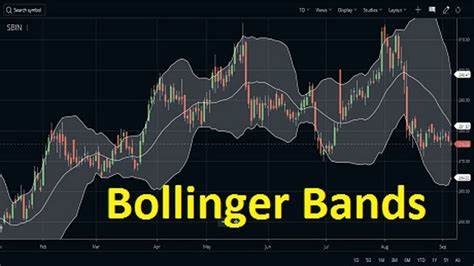
Bollinger Bands consist of three lines plotted on a price chart: a middle band (typically a 20-period simple moving average) and two outer bands positioned at standard deviations away from the middle band. The standard formula for Bollinger Bands is:

Middle Band = 20-period simple moving average (SMA) Upper Band = Middle Band + (20-period standard deviation of price × 2) Lower Band = Middle Band – (20-period standard deviation of price × 2)

The parameters (20-period and 2 standard deviations) can be adjusted based on trading preferences and timeframes, though the standard settings remain widely used for their proven effectiveness. The brilliance of Bollinger Bands lies in their statistical foundation: approximately 95% of price action occurs within the bands, making excursions beyond them statistically significant events.

These bands serve multiple functions: they measure market volatility, identify potential overbought or oversold conditions, and provide reference points for price movements. Their effectiveness stems from their ability to provide context-specific information rather than rigid buy or sell signals. Research indicates that Bollinger Bands perform optimally when combined with other technical analysis tools, particularly momentum indicators or volume analysis.

How To Read Bollinger Bands: Key Components

Understanding Bollinger Bands requires familiarity with their three primary components:

1. Middle Band (20-period SMA): This component establishes the baseline for price action and often acts as a dynamic support or resistance level. The direction of this moving average provides important information about the prevailing market trend. An upward-sloping middle band suggests bullish momentum, while a downward slope indicates bearish sentiment.

2. Upper Band: Positioned two standard deviations above the middle band, the upper band represents a statistical ceiling where prices might encounter resistance. When prices touch or exceed this band, the asset may be considered overbought, though this must be confirmed with additional analysis.

3. Lower Band: Located two standard deviations below the middle band, the lower band acts as a statistical floor where prices may find support. Prices reaching this level might indicate oversold conditions, potentially signaling buying opportunities when confirmed by other indicators.

The width between the bands — known as Bollinger Band Width — provides critical information about market volatility. Expanding width signals increasing volatility, while contracting width suggests decreasing volatility, often preceding significant price movements.

How To Use Bollinger Bands for Trading

Bollinger Bands offer multiple trading applications, each leveraging the statistical properties of the indicator:

  • Bollinger Bands Squeeze: When volatility decreases, the bands contract, creating what’s called a “squeeze.” This pattern frequently precedes significant price movements, though it doesn’t predict direction. Traders watch for the squeeze followed by a decisive price movement accompanied by increased volume as confirmation of a potential breakout opportunity.
  • Trading the Bounce: This strategy capitalizes on the tendency of prices to revert to the mean. When prices touch the outer bands and show reversal signals (such as candlestick patterns or momentum divergence), traders may enter positions anticipating a move toward the middle band. This approach works best in range-bound markets rather than strong trends.
  • Trend Identification with Middle Band Direction: The slope and direction of the middle band provide valuable trend information. In strong uptrends, prices often fluctuate between the middle and upper bands, while in downtrends, prices typically move between the middle and lower bands. The middle band serves as a dynamic support/resistance level and can be used for identifying trends within different timeframes.
  • Identifying Potential Overbought and Oversold Levels: When prices reach the outer bands, they enter statistically significant territory. However, contrary to common misconception, touching the bands alone doesn’t constitute a trading signal. Look for price rejection, reversal patterns, or divergences with other indicators before taking action.

Bandwidth interpretation adds another analytical dimension. Narrowing bands indicate decreasing volatility and often precede significant price movements. Experienced traders recognize that the longer and more pronounced the squeeze, the more powerful the subsequent breakout may be. This pattern works effectively across multiple timeframes and markets.

Managing Risk With the Bollinger Bands Indicator

Effective risk management remains paramount when using Bollinger Bands in your investment strategies. Placing stop-loss orders slightly beyond the bands can provide a systematic approach to risk control. For example, in a bullish setup using the lower band as support, a stop-loss might be positioned just below the lower band to limit potential losses if the anticipated support fails.

Take-profit targets can be established using bandwidth as a reference. A common approach involves using the distance between the entry point and the middle band as a minimum profit target. More aggressive targets might extend to the opposite band, though this requires careful consideration of overall market conditions.

Position sizing deserves special attention when trading with Bollinger Bands. Periods of low volatility (narrow bands) typically carry lower risk but offer greater potential reward on breakouts, potentially justifying larger position sizes. Conversely, wide bands signal high volatility, suggesting more conservative position sizing to account for increased price fluctuations.

Common Mistakes To Avoid When Using Bollinger Bands

Several pitfalls can undermine trading success with Bollinger Bands:

  • Isolated Use: Relying solely on Bollinger Bands without confirmation from other indicators often leads to false signals. Combining them with momentum oscillators, volume analysis, or support/resistance levels significantly improves signal quality.
  • Misinterpreting Band Touches: A common error involves automatically entering trades when prices touch the outer bands. Price contact with bands merely indicates statistical extremes, not definitive reversal points. Wait for confirming signals before committing capital.
  • Ignoring Timeframe Consistency: Analysis across multiple timeframes yields more reliable signals. A Bollinger Band signal on a daily chart carries more weight when confirmed by similar patterns on weekly and hourly charts.
  • Fixed Parameter Adherence: While standard settings (20-period, 2 standard deviations) work well across many markets, different assets and trading styles may benefit from parameter adjustments. Experimentation and optimization improve performance.
  • Overlooking Market Context: Bollinger Bands perform differently in trending versus range-bound markets. In strong trends, prices can “walk the band,” remaining at statistical extremes longer than expected and frustrating mean-reversion strategies.

Using Bollinger Bands in Your Investments

Bollinger Bands represent a powerful addition to any trader’s analytical toolkit, offering statistically significant insights into price behavior and market volatility. Their effectiveness increases substantially when incorporated into a comprehensive trading approach that includes additional technical tools, fundamental analysis, and sound risk management practices.

For traders serious about advancing their investing capabilities, mastering Bollinger Bands provides an edge in identifying potential trading opportunities across various market conditions. Their mathematical foundation in statistical analysis makes them particularly valuable for developing systematic, rules-based trading strategies.

To further enhance your trading proficiency with Bollinger Bands and other technical analysis tools, consider upgrading to Above the Green Line’s premium membership. Our advanced tutorials, expert analysis, and proprietary trading systems can help transform your understanding of market dynamics and improve trading outcomes. Visit our membership page to explore how our resources can accelerate your trading journey.

Related Articles

MACD Indicator

MACD Indicator: How To Use Moving Average Convergence Divergence in Trading

The Moving Average Convergence Divergence (MACD) indicator is one of the most widely used technical analysis tools available to traders ...
Read More
Fibonacci Retracement

Fibonacci Retracement: How To Use It for Support, Resistance, and Trade Entries

Knowing how to identify key price levels is critical in any successful trading methodology. Among the most relied-upon tools for ...
Read More
Bollinger Bands

Bollinger Bands: How to Trade Volatility and Spot Breakout Opportunities

Bollinger Bands represent one of the most versatile tools in technical analysis, providing traders with important information about price volatility ...
Read More
Rounding Bottom Pattern

Rounding Bottom Pattern: How to Trade This Gradual Bullish Reversal

In trading, the rounding bottom pattern represents a significant bullish reversal formation that develops gradually over extended periods. This pattern ...
Read More
Rectangle Pattern in Trading

Rectangle Pattern in Trading: How To Identify and Profit from Price Consolidation

In technical analysis, price action often moves in identifiable patterns. Among the most common and reliable is the rectangle pattern ...
Read More
  • 1
  • 2
  • 3
  • …
  • 15
  • Next
Loading...

May 1, 2025

Rounding Bottom Pattern: How to Trade This Gradual Bullish Reversal

Rounding Bottom Pattern

By ATGL

Updated May 1, 2025

In trading, the rounding bottom pattern represents a significant bullish reversal formation that develops gradually over extended periods. This pattern manifests as a distinctive “U” shape on price charts, signaling a transition from bearish to bullish market sentiment. For investors and traders analyzing stock charts, identifying this pattern offers valuable opportunities to capitalize on potential long-term uptrends.

Understanding the Rounded Bottom Pattern

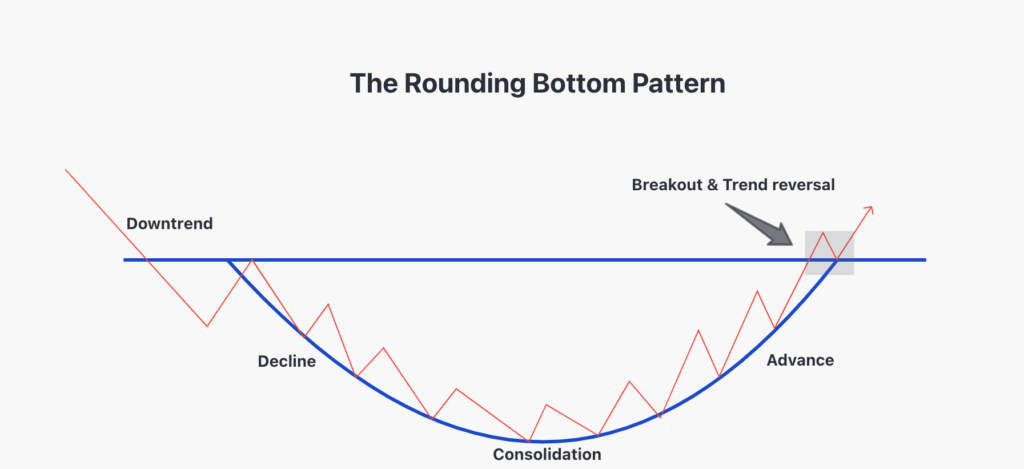
The rounded bottom pattern, also known as a saucer bottom, forms when price action gradually shifts from a downtrend to an uptrend, creating a bowl or “U” shaped appearance on charts. Unlike abrupt reversal patterns, the rounding bottom develops over extended periods—typically several months to years—making it particularly relevant for intermediate to long-term investors.

This pattern illustrates a gradual transfer of market control from sellers to buyers. Initially, selling pressure dominates, causing steady price declines. As the pattern progresses, selling pressure diminishes while buying interest increases, creating a smooth curve that eventually transitions into an uptrend. The extended formation period allows for thorough price consolidation, often resulting in stronger subsequent uptrends compared to patterns that develop rapidly.

When properly identified, the rounded bottom offers valuable insight into shifting market psychology. The pattern effectively captures the gradual exhaustion of selling pressure and the building of buying momentum, providing traders with strategic entry points before significant upward price movements materialize.

How To Identify the Rounded Bottom Pattern

Accurate identification of the rounded bottom pattern requires recognizing three distinct phases that characterize its formation.

Price Exhaustion Phase

Initially, prices decline within an established downtrend. This phase represents the left side of the “U” shape, where selling pressure gradually diminishes. Identifying this phase involves observing decreasing momentum in the downtrend, often accompanied by contracting volume. When drawing stock charts, traders should note that this phase often takes considerable time to develop.

Bottom Formation Phase

The central portion of the pattern occurs as prices stabilize and create the curved bottom of the “U” shape. This consolidation period represents market equilibrium where selling pressure has largely dissipated while buying pressure has not yet fully materialized. Volume typically remains relatively low during this phase as market participants reach a temporary consensus on price.

Breakout Phase

The right side of the “U” forms as prices begin ascending, reflecting increasing buyer momentum. This phase culminates in a breakout above the resistance level (or “neckline”) established by the pattern’s left side. The breakout represents the final confirmation of the pattern and signals the beginning of a potential new uptrend. Volume should expand significantly during this phase, validating the pattern’s completion.

For optimal pattern recognition, investors should examine longer-term charts—daily, weekly, or monthly timeframes—as the rounded bottom develops gradually. Confirmation through multiple technical indicators substantially improves identification accuracy.

How To Trade the Rounded Bottom Pattern

Trading the rounded bottom pattern effectively requires a methodical approach.

Pattern Identification

First, the trader will locate potential rounded bottom formations on longer-term charts. The pattern should display a clear “U” shape with relatively symmetrical sides. Price action should demonstrate gradual transitions rather than sharp movements, particularly at the bottom of the formation.

Volume Confirmation

Volume analysis provides critical validation for the pattern. Ideally, volume declines during the downtrend (left side), remains low during consolidation (bottom), and expands significantly during the uptrend (right side), especially at the breakout point. This volume signature confirms the transfer of market control from sellers to buyers.

Entry Strategies

Conservative traders typically enter positions after price breaks above the pattern’s neckline (resistance level established by the left side peak), with increased volume confirming the breakout. More aggressive traders might establish positions during the bottom formation phase when prices show initial signs of reversal, though this approach carries higher risk.

Exit Points

Profit targets can be established using the pattern’s depth. Measuring from the lowest point of the pattern to the neckline and projecting this distance upward from the breakout point provides a reasonable profit objective. Alternatively, traders can implement trailing stops to capture potential extended trends.

Technical Indicator Integration

Supplementing pattern analysis with technical indicators enhances trading precision. Moving averages can confirm trend direction, while momentum indicators like RSI and MACD help spot reversals early. Divergence between price and momentum indicators often signals potential reversals before the pattern completes.

Risk Management Strategies for Trading With the Rounded Bottom

Implementing robust risk management practices proves essential when trading the rounded bottom pattern:

  • Strategic Stop-Loss Placement: Traders should position stop-loss orders below recent support levels or swing lows. For entries at the pattern breakout, placing stops below the neckline protects against false breakouts. When entering during the bottom formation phase, stops should be placed below the most recent low within the pattern.
  • Position Sizing: Traders should limit exposure to any single trade based on its risk profile. The extended formation time of rounding bottoms increases the risk of premature entries. Calculating position size based on the distance to stop-loss points helps maintain consistent risk levels across different trading opportunities.
  • Trading Plan Execution: Traders should develop and adhere to a predetermined trading plan that specifies entry criteria, stop-loss levels, and profit targets. The gradual nature of rounded bottoms may tempt traders to enter positions prematurely, making disciplined plan execution particularly important.
  • Trade Diversification: Traders should distribute capital across multiple non-correlated securities exhibiting rounding bottom patterns. This approach reduces risk exposure to any single trade while potentially increasing overall portfolio performance.

Benefits and Limitations of Rounding Bottoms

Trading the rounded bottom pattern offers distinct advantages:

  • Strong Reversal Signals: The extended formation period typically produces more reliable reversals compared to patterns that develop rapidly. The gradual transition from bearish to bullish sentiment allows for thorough price consolidation, often resulting in stronger subsequent trends.
  • Cross-Market Application: While commonly identified in stock markets, the pattern applies effectively across various financial instruments, including commodities, currencies, and indices. This versatility allows traders to implement consistent strategies across different market segments.
  • Clear Risk Parameters: The well-defined structure enables precise stop-loss placement and profit targeting, facilitating favorable risk-to-reward ratios when properly executed.

Despite these benefits, traders should recognize important limitations:

  • Extended Formation Time: The pattern’s gradual development requires considerable patience, potentially tying up capital for extended periods before confirmation occurs.
  • False Breakouts: Like many chart patterns, rounded bottoms may produce false signals, particularly in volatile market conditions. Verification through multiple confirmation methods becomes essential.
  • Context Sensitivity: The pattern’s effectiveness varies based on broader market conditions, industry trends, and fundamental factors affecting the security. Analysis should incorporate these contextual elements rather than relying solely on the pattern itself.

Using Rounding Bottom in Your Strategy

The rounded bottom pattern represents a powerful analytical tool for identifying potential long-term trend reversals. When incorporated within a comprehensive trading patterns strategy, this formation helps traders capitalize on shifting market momentum as sellers gradually relinquish control to buyers. By combining pattern recognition with volume analysis and technical indicators, traders gain valuable insight into potential market turning points.

Effective trading requires both technical proficiency and proper risk management. Implementing disciplined entry and exit strategies while maintaining appropriate position sizing maximizes the pattern’s analytical value. For investors seeking to further enhance their technical analysis capabilities, Above the Green Line offers comprehensive resources and membership options to develop advanced chart pattern recognition skills and implement effective trading strategies. Explore our membership options to access professional-grade tools and education for navigating these powerful technical formations.

Related Articles

MACD Indicator

MACD Indicator: How To Use Moving Average Convergence Divergence in Trading

The Moving Average Convergence Divergence (MACD) indicator is one of the most widely used technical analysis tools available to traders ...
Read More
Fibonacci Retracement

Fibonacci Retracement: How To Use It for Support, Resistance, and Trade Entries

Knowing how to identify key price levels is critical in any successful trading methodology. Among the most relied-upon tools for ...
Read More
Bollinger Bands

Bollinger Bands: How to Trade Volatility and Spot Breakout Opportunities

Bollinger Bands represent one of the most versatile tools in technical analysis, providing traders with important information about price volatility ...
Read More
Rounding Bottom Pattern

Rounding Bottom Pattern: How to Trade This Gradual Bullish Reversal

In trading, the rounding bottom pattern represents a significant bullish reversal formation that develops gradually over extended periods. This pattern ...
Read More
Rectangle Pattern in Trading

Rectangle Pattern in Trading: How To Identify and Profit from Price Consolidation

In technical analysis, price action often moves in identifiable patterns. Among the most common and reliable is the rectangle pattern ...
Read More
  • 1
  • 2
  • 3
  • …
  • 15
  • Next
Loading...

May 1, 2025

Rectangle Pattern in Trading: How To Identify and Profit from Price Consolidation

Rectangle Pattern in Trading

By ATGL

Updated May 1, 2025

In technical analysis, price action often moves in identifiable patterns. Among the most common and reliable is the rectangle pattern — a formation that reflects a period of consolidation before the price breaks out in one direction. For traders aiming to make strategic, emotion-free investment decisions, recognizing this setup can lead to consistent returns, especially when paired with clear indicators for trading.

Understanding the Rectangular Pattern

A rectangular pattern represents a phase where the market pauses, reflecting a temporary equilibrium between buyers and sellers. Prices oscillate between a defined support level and a resistance level, forming horizontal boundaries that resemble a box or rectangle on the chart.

This period of sideways price action is neither random nor insignificant. It indicates market indecision, where neither bulls nor bears dominate, and the price stabilizes within a range. Despite its apparent calmness, this pattern often precedes powerful price moves once a breakout occurs.

The rectangular shape of the pattern reflects a clear equilibrium zone. Buyers repeatedly enter at support, while sellers dominate at resistance. Recognizing this range-bound behavior allows traders to anticipate future price movement once the balance shifts decisively.

How To Identify the Rectangle Pattern

Successfully identifying a rectangle pattern depends on understanding its technical characteristics. Key traits include:

  • Parallel Support and Resistance Lines: The top and bottom of the pattern align with relatively equal highs and lows, forming a horizontal channel.
  • Price Consolidation: The asset trades within this range for a period, indicating equilibrium in supply and demand.
  • Equal Highs and Lows: Price repeatedly tests resistance and support levels without breaking them, showing strong boundaries.
  • Volume Analysis: Typically, volume diminishes during the pattern’s development and increases sharply at breakout.
  • Duration: Rectangle formations can last from several days to several months. Longer patterns often precede more substantial breakouts.

Paying attention to volume is critical. During consolidation, volume often declines, signaling reduced conviction from both buyers and sellers. A breakout with a sharp volume increase strengthens the validity of the move, helping traders distinguish genuine breakouts from false signals.

Using these criteria alongside tools like moving averages or stochastic indicators can enhance pattern recognition and improve entry timing.

Types of Rectangle Patterns

One of the most common questions is: Is a rectangle pattern bullish or bearish? The answer depends on the direction of the breakout. Most often, the rectangle is a continuation pattern, meaning it signals a pause before the prevailing trend resumes. However, it can also mark a reversal in rare cases, which is why breakout confirmation is critical.

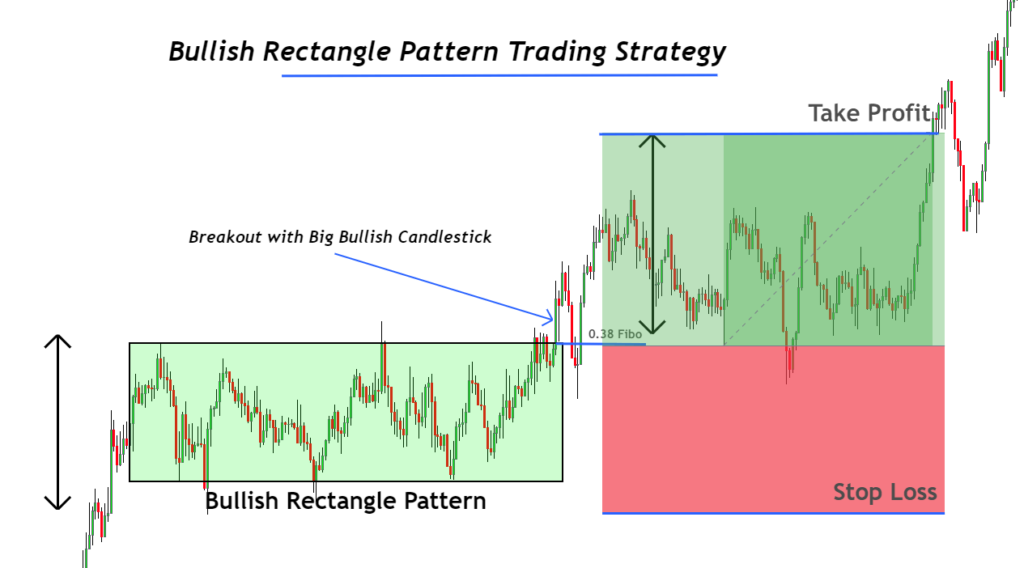
Bullish Rectangle Pattern

A bullish rectangle pattern occurs during an uptrend when the price enters a consolidation phase but ultimately breaks out to the upside. It reflects temporary resistance as profit-taking sets in, yet buyers remain strong enough to maintain support.

Key Features:

  • Occurs in uptrends
  • Price bounces between resistance and support
  • Volume contracts during consolidation
  • Breakout to the upside confirms continuation

Traders may set buy orders slightly above the resistance level to enter positions as momentum resumes upward.

Bearish Rectangle Pattern

In contrast, a bearish rectangle pattern emerges during a downtrend. It indicates a pause in bearish momentum but ultimately breaks down further as sellers regain control.

Key Features:

  • Appears in a downtrend
  • Defined horizontal range
  • Volume fades during consolidation
  • Bearish breakout confirms downtrend continuation

Short positions can be initiated just below the support level to capitalize on renewed downside movement.

Strategies for Trading Rectangle Patterns

To profit from the rectangle pattern, traders should tailor their strategies to the breakout direction:

1. Breakout Entry Strategy

  • For Bullish Rectangle: Buy when price closes above the upper resistance. Confirm with increasing volume.
  • For Bearish Rectangle: Sell short after price breaks below support. Again, volume confirmation is crucial.

2. Pullback Re-entry

  • After a breakout, wait for a retest of the broken level (support becomes resistance or vice versa) for a lower-risk entry.

3. Measured Move Target

  • Estimate the price target by measuring the rectangle’s height and projecting it from the breakout point. This technique applies to both bullish and bearish patterns.

4. Use Stop-Loss Orders

  • Place stops just below support (bullish) or above resistance (bearish) to protect against false breakouts.

Incorporating trade alerts or automated entry systems can enhance execution, especially in fast-moving markets. For those focused on disciplined investing, using rectangle formations to time entries and exits helps remove emotion from decision-making and supports systematic portfolio growth.

Recognizing Market Consolidation

A rectangle formation is essentially a visual representation of market consolidation. Understanding the forces behind it helps validate the pattern:

Supply and Demand Balance

During the rectangle phase, buying and selling pressures are evenly matched. Traders must monitor volume trends and price reactions to identify when this balance begins to shift, potentially signaling an upcoming breakout.

Sideways Market Movements

This type of movement can frustrate directional traders, but it presents opportunities for those who wait patiently for confirmation. Sideways trends often occur before earnings reports, macroeconomic events, or major news catalysts, where uncertainty causes investors to pause.

Leverage the Rectangle Pattern Formations

Integrating the rectangle pattern trading technique into a broader strategy requires discipline and systematized analysis. Here’s how to extract maximum value:

  • Use charting platforms with reliable types of stock charts that clearly display support and resistance.
  • Combine rectangle identification with technical indicators for trading, such as RSI, MACD, or moving averages, to filter low-probability setups.
  • Subscribe to timely trade alerts to avoid missing breakout opportunities.

Traders who consistently apply these rules gain a tactical edge by entering positions aligned with the breakout’s momentum rather than guessing market direction.

Understanding what a rectangle pattern indicates about market behavior — namely, a standoff between supply and demand — enables more strategic entries and exits. And knowing how you can profit from breakouts after a rectangle consolidation allows for preemptive trade planning and risk management.

By mastering the best strategies for trading rectangle patterns, you can reduce emotional decision-making and adhere to a more systematic approach, which is exactly the foundation we use at Above the Greenline.

Our memberships provide access to curated trade alerts, chart setups, and model-driven insights designed to help you identify high-probability opportunities before the breakout happens. Join us to take a more structured and data-backed approach to investing.


Related Articles

MACD Indicator

MACD Indicator: How To Use Moving Average Convergence Divergence in Trading

The Moving Average Convergence Divergence (MACD) indicator is one of the most widely used technical analysis tools available to traders ...
Read More
Fibonacci Retracement

Fibonacci Retracement: How To Use It for Support, Resistance, and Trade Entries

Knowing how to identify key price levels is critical in any successful trading methodology. Among the most relied-upon tools for ...
Read More
Bollinger Bands

Bollinger Bands: How to Trade Volatility and Spot Breakout Opportunities

Bollinger Bands represent one of the most versatile tools in technical analysis, providing traders with important information about price volatility ...
Read More
Rounding Bottom Pattern

Rounding Bottom Pattern: How to Trade This Gradual Bullish Reversal

In trading, the rounding bottom pattern represents a significant bullish reversal formation that develops gradually over extended periods. This pattern ...
Read More
Rectangle Pattern in Trading

Rectangle Pattern in Trading: How To Identify and Profit from Price Consolidation

In technical analysis, price action often moves in identifiable patterns. Among the most common and reliable is the rectangle pattern ...
Read More
  • 1
  • 2
  • 3
  • …
  • 15
  • Next
Loading...
  • 1
  • 2
  • 3
  • …
  • 15
  • Next Page »

Subscribe to Our Newsletter

AGL Logo

Get our eBook Now!

Candlestick - A Swing Traders Friend

We don’t spam! Read our privacy policy for more info.

Check your inbox or spam folder to confirm your subscription.

Voted #1 at Stock Charts

SH Chart
Inverse S&P 500 Fund (SH) will have a Money Wave Buy today.

Help Us Help Animals

Help Us Help Animals

Recent Comments

  • AbovetheGreenLine on Green Line Weekly Aug 27, 2023
  • lbrodt on Green Line Weekly Aug 27, 2023
  • Mitch Van Zelfden on Money Wave Alert! Jul 31, 2023
  • AbovetheGreenLine on Money Wave Alert! Jul 31, 2023
  • Mitch Van Zelfden on Money Wave Alert! Jul 31, 2023

Become a Green Liner!

Help me make more Money in the Stock Market.

Investing with Rules.

On ATGL

  • DashBoard
  • Weekly Commentary
  • Daily Buy / Sell Signals
  • Day Trade Setup
  • Trading Rooms

Strategies

  • Swing Trading
  • ATGL Pick of the Week
  • Dividend Growth
  • ETF Sector Rotation
  • Dogs of the Dow

Help

  • ATGL Trading Rules
  • FAQ
  • Account Maintenance
  • Contact US
  • Join

Stay Updated

No credit card required. Unsubscribe anytime

Check your inbox or spam folder to confirm your subscription.

© 2024 Above The Green Line. All rights reserved.

  • Twitter
  • LinkedIn
  • YouTube