• Market Insights
        • Commentary
          • Daily
          • Weekly
        • BUY / SELL SIGNALS
          • Trade Posts
          • Recent Trade Alerts
          • Recent Day Trades
        • BLOGROLL
          • Dividend Growth Blog
          • ETF Sector Blog
          • Dow Dogs
          • TPOW Blog
  • Strategies
        • SWING TRADING
          • Current Positions
          • Watchlists
          • Closed Positions
          • Candidates - TOP 100
          • Specialty Stocks
        • WEEKLY STOCK PICK
          • TPOW Charts
          • TPOW Performance
          • TPOW Strategy Guide
          • TPOW Performance Dashboard
        • DAY TRADING
          • Watch List
        • ATGL DASHBOARD
        • ETF STRATEGIES
          • ETF Sector Rotation
          • ETF Sector Portfolio
        • DIVIDEND GROWTH
          • Dividend Growth Portfolio
          • Dividend Calendar
        • DOGS OF THE DOW
          • Dogs of the Dow Portfolio
          • DOW 5 Portfolio
  • Markets
        • US MARKET
          • Commodities
          • Energy
          • Precious Metals
          • Volatility
        • GLOBAL MARKETS
          • Market Indices
          • Economic Calendar
          • FOREX Heat Map
          • FOREX Cross Rates
          • Crypto Currency Market
  • Investing
    • Discord Community
    • Dashboard
  • Resources
        • ARTICLES
          • Dividend Growth Model Articles
          • ETF Articles
          • Investment Strategies Articles
          • Market and Economic Insights
          • Stock Trade Articles
          • Stock Reviews
        • TOOLS
          • Stock Scanners
          • Charting Software
          • Brokerage Firms
        • STOCK CHARTS
          • Key Components
          • Reading Charts
          • Drawing Stock Charts
          • Identifying Trends
        • RETIREMENT PLANNING
  • About
    • Contact Us
    • How to Win
    • #1 At Stockcharts
    • Disclaimer
    • FAQ
  • Log In
  • Subscribe
Menu
  • Market Insights
    • Commentary
      • Daily
      • Weekly
    • BUY / SELL SIGNALS
      • Trade Posts
      • Recent Trade Alerts
      • Recent Day Trades
    • BLOGROLL
      • Dividend Growth Blog
      • ETF Sector Blog
      • Dow Dogs
      • TPOW Blog
  • Strategies
    • SWING TRADING
      • Current Positions
      • Watchlists
      • Closed Positions
      • Candidates – TOP 100
      • Specialty Stocks
    • DAY TRADING
      • Watch List
    • WEEKLY STOCK PICK
      • TPOW Charts
      • TPOW Performance
      • TPOW Strategy Guide
      • TPOW Performance Dashboard
    • DIVIDEND GROWTH
      • Dividend Growth Portfolio
      • Dividend Calendar
    • DOGS OF THE DOW
      • Dogs of the Dow Portfolio
      • DOW 5 Portfolio
    • ETF STRATEGIES
      • ETF Sector Rotation
      • ETF Sector Portfolio
    • ATGL DASHBOARD
  • Markets
    • US MARKET
      • Commodities
      • Energy
      • Precious Metals
      • Volatility
    • GLOBAL MARKETS
      • Market Indices
      • Economic Calendar
      • FOREX Heat Map
      • FOREX Cross Rates
      • Crypto Currency Market
  • Investing
    • Discord Community
    • Dashboard
  • Resources
    • ARTICLES
      • Dividend Growth Model Articles
      • ETF Articles
      • Investment Strategies Articles
      • Market and Economic Insights
      • Stock Trade Articles
      • Stock Reviews
    • TOOLS
      • Stock Scanners
      • Charting Software
      • Brokerage Firms
    • STOCK CHARTS
      • Key Components
      • Reading Charts
      • Drawing Stock Charts
      • Identifying Trends
    • RETIREMENT PLANNING
  • About
    • Contact Us
    • How to Win
    • #1 At Stockcharts
    • Disclaimer
    • FAQ
  • Log Out
    • Members-Page
    • Referral
  • Log In
  • Subscribe
Log In
Log Out
Subscribe

July 28, 2020

How the Federal Reserve Impacts the Stock Market

How the Federal Reserve Impacts the Stock Market

The Federal Reserve System is the central banking system of the United States that is responsible for encouraging healthy operations within the economy as well as reflecting public interest. It advertises five primary duties that help maintain and grow the U.S. economy. To begin, the Fed conducts the country’s monetary policy in order to boost employment, stabilize prices, and to attempt to ensure moderate long-term interest rates. Additionally, the Fed seeks to minimize the ramifications of potentially detrimental events that could affect the U.S. economy. Thirdly, the Fed is responsible for keeping financial institutions secure while also monitoring their activities. Furthermore, the Fed promotes consumer safety and community development by researching new trends and developments. Lastly, the Fed facilitates services between the banking industry and the United States government. There are twelve Federal Reserve Banks dispersed throughout the country; to see where they are, click here.

Impacts on the Stock Market

The primary concern of the Fed surrounds preventing inflation from destroying the economy. If the economy grows too quickly, inflation can skyrocket and severely affect economic conditions. On the other hand, if the economy slows down too quickly, inflation will stall. Inflation and interest rates have an inverse relationship; thus, the Fed attempts to regulate inflationary conditions by utilizing interest rates. When the economy is growing too quickly and inflation is high, the Fed will increase interest rates to reverse the rise of inflation. Conversely, when the economy is slowing down and inflation is low, the Fed will decrease interest rates to stimulate the economy.

The Fed’s control over interest rates has a direct effect on investors of the stock market. Take bonds for example. The price of bonds is inversely related to interest rates. When rates are high, bond prices are low and vice versa. If an investor purchased a bond with an interest rate of 5%, and then shortly after the Fed lowered the interest rate to 4%, the investor’s older bond would be paying more interest than bonds accrued in the present. Conversely, if an investor purchased a bond with an interest rate of 5% and then shortly after interest rates were raised to 6%, an investor would be losing out on current gains. To capture the higher return, the investor would have to pay a premium on their bond.

The effects of interest rates on bonds are clear-cut and carry certainty. However, the same cannot be said about the effects of interest rates on stocks. According to multiple studies, there is conflicting data surrounding the relationships between stocks and interest rates; many consider it to be impossible to make informed decisions about one’s portfolio based on interest rates. Though the relationship between the two is unclear, it does not mean that stocks entirely lack a relationship with interest rates. When interest rates decline, businesses can acquire loans to pursue new projects and operations at a lower cost. Consequently, a business’s customers spend less on service debt and more on the products and services of the business. Thus, declining interest rates can cause an increase in the price of a business’s stock. It should be noted that purchasing stock in a declining-rate environment is not always straightforward; simply because interest rates are low does not signal that the price of a stock will increase in the future. The Dimension Fund Advisors conducted a large study surrounding the relationship between interest rates and equity. By comparing stock returns to interest rates between 1954 and 2016, it found that there was “no discernible relationship” between the two. Furthermore, the study found that while interest rates were increasing stock returns ranged from -15.56% to 14.27%. In months when rates were declining, stock returns ranged from -22.41% to 16.52%. While interest rates and stocks sometimes illustrate a relationship, the correlation is not defined and should be used carefully when making investment decisions.

The Effects on the Stock Market Today

In early/mid-March, the financial markets experienced extreme volatility due to COVID-19. The global pandemic caused a multitude of consequences for the U.S. economy; it became difficult to borrow for longer than overnight, trading became impaired, and borrowers found that credit became unavailable. The ramifications on those markets affected those that participated in them, yet they also affected those who did not due to their central role within the U.S. financial system. COVID-19’s effects on the markets could potentially lead to families having trouble receiving mortgages with affordable interest rates, businesses having trouble operating and paying their workers, and governments having trouble funding essential enterprises. Thus, the Fed was forced to act quickly to prevent could be deemed the worst economic decline since the Great Depression.

How does this affect investors? Take short-term funding markets for example. As previously mentioned, these short-term funding markets became extremely debilitated at the beginning of March. Due to this, investors became hesitant to purchase commercial paper. Funds that invested in commercial paper saw an outflow of $150 billion in March alone as investors became concerned that they would not be able to sell their holdings.

Conclusion

It might not always be wise to observe the actions of the Fed and make financial decisions based upon them. However, it is important to comprehend the financial markets of today, including but not limited to international dollar funding, mortgage-backed securities, and credit markets, and how are deeply interwoven they are with each other. Financial stress in one market leads to stress within another, and can ultimately cause an economic disaster. Investors are not exempt to this strain, neither are individuals, nor corporations, nor governmental entities. During a time of crisis, economic conditions affect everyone’s ability to own a home, to feed themselves, to build a future, etc. Thus, the actions of the Fed should be of great importance to everyone, investors and citizens alike.


Related Articles

MACD Indicator

MACD Indicator: How To Use Moving Average Convergence Divergence in Trading

The Moving Average Convergence Divergence (MACD) indicator is one of the most widely used technical analysis tools available to traders ...
Read More
Fibonacci Retracement

Fibonacci Retracement: How To Use It for Support, Resistance, and Trade Entries

Knowing how to identify key price levels is critical in any successful trading methodology. Among the most relied-upon tools for ...
Read More
Bollinger Bands

Bollinger Bands: How to Trade Volatility and Spot Breakout Opportunities

Bollinger Bands represent one of the most versatile tools in technical analysis, providing traders with important information about price volatility ...
Read More
Rounding Bottom Pattern

Rounding Bottom Pattern: How to Trade This Gradual Bullish Reversal

In trading, the rounding bottom pattern represents a significant bullish reversal formation that develops gradually over extended periods. This pattern ...
Read More
Rectangle Pattern in Trading

Rectangle Pattern in Trading: How To Identify and Profit from Price Consolidation

In technical analysis, price action often moves in identifiable patterns. Among the most common and reliable is the rectangle pattern ...
Read More
Bullish Pennet Pattern

Bullish Pennant Pattern: How to Trade This Powerful Continuation Signal

The bullish pennant pattern ranks among the most reliable continuation patterns in technical analysis. This pattern signals a temporary pause ...
Read More

December 26, 2019

Multiple Time Frame Strategy

Multiple Time Frame Strategy

By Author

Updated October 2, 2024

What is Multiple Time Frame Analysis?

The multiple time frame investment strategy can best be defined as an approach that examines securities at different intervals of time. A security is any financial instrument that holds monetary value. It can be a stock, bond, currency pair, etc. When using multiple time frame analysis, an investor will typically examine three or more different periods of time; any less than this can result in a considerable loss of data. Generally, analysts believe that the more intervals surveyed, the more reliable the data. However, when it comes to exactly what intervals should be surveyed, it varies.

How to Use

How one employs multiple time frame analysis depends entirely on the investor’s strategy. For instance, a long term trader might examine data over weeks to months while a swing trader may focus on weekly or daily charts to identify short term trends. A day trader may identify short term trends using minute charts that can range from 15 to 240-minutes. There are many ways an investor can utilize this approach. Commonly, once an investor decides upon their desired holding period they will settle into their choice and seldom think to change it. While stability can be beneficial, being unable to consider a change in methodology can cause one to overlook the bigger picture. On the other hand, switching from time frame to time frame impulsively is often unwise. It is important to find a middle ground between these two extremes and consider data from a multitude of time frames.

Multiple time frame analysis over time
http://tradetight.org/forums/thread-view.asp?tid=1017&posts=2&start=1

The Significance of the Time Frame Scale

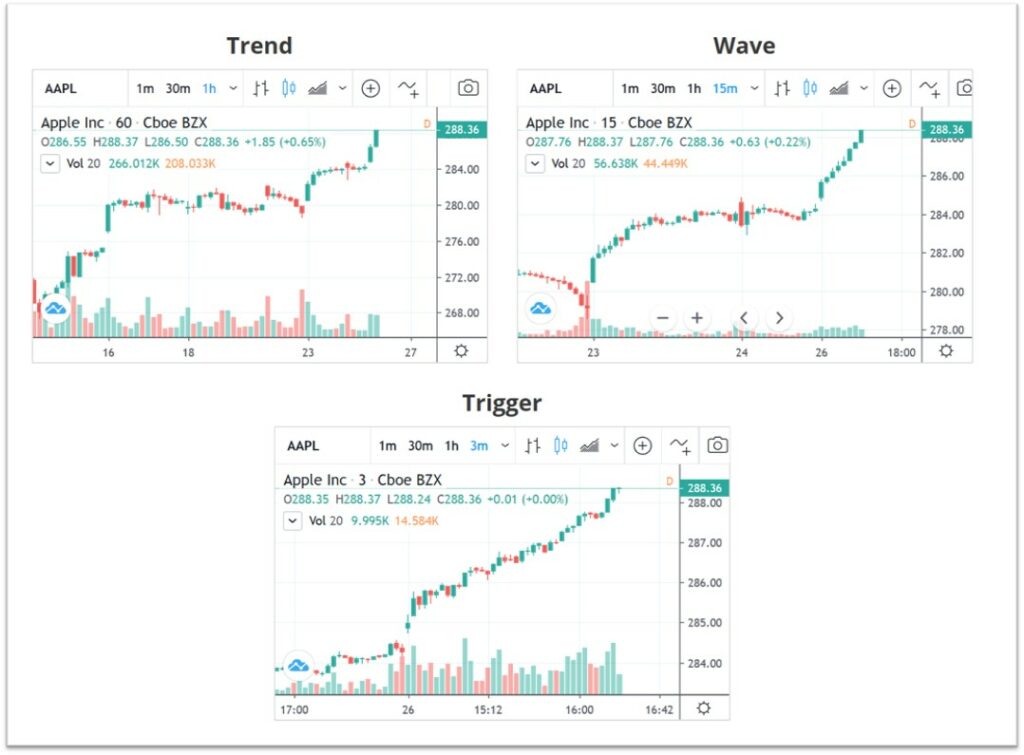
As seen in the image below, security can be examined over a long and/or short period of time. Here, we will discuss the meaning and importance of the examination of a range of time frames from long to short-term. Examining a long-term time frame will provide the dominant trend. It is commonly advised to trade in the direction of the dominant trend for results with a larger expectation of profit. Nevertheless, one could still trade against the dominant trend. The fundamentals of fundamental analysis, as discussed in a prior article, have a large impact on the direction of the trend and should be frequently observed. Additionally, interest rates are another component to monitor when utilizing a long-term time frame as they are crucial to determining financial instruments such as the exchange rate.

Out of the three, the medium-term time frame is the most flexible due to the fact that it has components of both long-term and short-term frequencies. When observing this time frame, one is able to zoom in on the broader, dominant trend and thus smaller components come to light. Applying the medium-term time frame is particularly significant as one should plan their trade at this stage.

Lastly, the short-term time frame is the point of action. While examining this time frame, price fluctuations become increasingly more clear. Due to this, a trader is able to better choose a point of entry. It is important to note that fundamental components and economic indicators do play a role in this time frame, but one that is very short-term. The narrowness of this particular examination causes the role of fundamentals to appear grand and volatile, but normally the changes they create do not stick around for too long. However, it is still imperative one observes them as a trader should avoid making decisions during a temporary imbalance.

From long to short-term, each time frame has its benefits that are crucial when it comes to participating in a trade. When all three of the time frames are considered and employed correctly in the evaluation of securities, the probability of success for a trader improves significantly.

Key Takeaways

Overall, applying multiple time-frame analysis can greatly improve the outcome of a trade. Settling into a specified comfort zone is more than likely of no benefit to a trader. Multiple time frame analysis provides a comprehensive view of security trade that will result in a larger profit target for a trader.

Apple Inc. Multiple Time Frame Analysis

Related Articles

MACD Indicator

MACD Indicator: How To Use Moving Average Convergence Divergence in Trading

The Moving Average Convergence Divergence (MACD) indicator is one of the most widely used technical analysis tools available to traders ...
Read More
Fibonacci Retracement

Fibonacci Retracement: How To Use It for Support, Resistance, and Trade Entries

Knowing how to identify key price levels is critical in any successful trading methodology. Among the most relied-upon tools for ...
Read More
Bollinger Bands

Bollinger Bands: How to Trade Volatility and Spot Breakout Opportunities

Bollinger Bands represent one of the most versatile tools in technical analysis, providing traders with important information about price volatility ...
Read More
Rounding Bottom Pattern

Rounding Bottom Pattern: How to Trade This Gradual Bullish Reversal

In trading, the rounding bottom pattern represents a significant bullish reversal formation that develops gradually over extended periods. This pattern ...
Read More
Rectangle Pattern in Trading

Rectangle Pattern in Trading: How To Identify and Profit from Price Consolidation

In technical analysis, price action often moves in identifiable patterns. Among the most common and reliable is the rectangle pattern ...
Read More
Bullish Pennet Pattern

Bullish Pennant Pattern: How to Trade This Powerful Continuation Signal

The bullish pennant pattern ranks among the most reliable continuation patterns in technical analysis. This pattern signals a temporary pause ...
Read More

November 22, 2019

Buy and Hold vs. Market Timing

Buy and Hold Investing or Market Timing?

By Author

Updated February 8, 2024

There is often debate between investors as to which investment method is better: a traditional buy-and-hold approach or market timing. Here, we will discuss the merits and challenges that both strategies present to hopefully give a better understanding of which method works best for you.

Market Timing

Market timing is a strategy that is highly debated as its methodology involves great risk and effort. In short, market timing is the ability to predict the market’s short term reversal points, meaning the right points in time to enter and exit the market. Since it is a short term approach, it requires a great deal of diligence as well as ample time to give to monitoring the market. Why participate in a high-risk scenario that requires a great deal of attention? Well, there is a potential for a high return. Over the past decade, the S&P 500’s annual average return is 9.10%. This is the average return that investors would experience using a more long term strategy. In contrast, those who use the methodology of market timing correctly can outperform this return greatly, thus gaining more profit in a shorter amount of time. For example, the chart below represents a sample taken over 63 years of the “best five trading days”; a strategy that outperforms the market’s annual return a total of forty-two times. However, this is an incredibly difficult game to play. Returns are often concentrated in a very short time span and the chances of receiving no returns or even worse, negative returns, are dangerously high considering no one can predict the future with complete accuracy. It is important to weigh the risks and benefits before engaging with market timing.

Chart showing the sums of the best five trading days according to the S&P 500

Buy and Hold Investing

Buy-and-hold investing, also known as passive management, varies greatly from market timing. Instead of predicting the right points to enter and exit the market, an investor employing a buy-and-hold approach selects securities or funds and then holds onto them long term with no focus on short term price fluctuations. It is generally thought that when employing this method one’s assets should not be needed for three to five years. Many investors are advocates of this method simply because it works. Since the buy-and-hold strategy is based entirely on fundamental analysis, there is no room for subjectivity. Forecasting the degree of growth, however, is subjective. The chart below illustrates this concept well as the probability of negative returns decreases greatly as time goes on. The benefits of a buy-and-hold strategy sound enticing; it requires little effort and over time will guarantee somewhat of a return. Nonetheless, it is important to note that there are consequences for utilizing this strategy. As previously discussed, a buy-and-hold strategy requires a significant time investment and it is up to the investor’s discretion just how long they would like to hold on. It is essential to know that one cannot expect a degree of return that matches the time invested. For instance, if an investor were to hold on to a stock for ten years, that does not guarantee it will represent the magnitude of time they spent without that asset. Lastly, there is always the possibility of a market crash. During a crash, buy-and-hold investors can lose most if not all of their gains. It is necessary to consider the pros and cons of a buy-and-hold strategy before participating in it.

Chart descirbing the relationship between time and probability of negative return

Key Takeaways

In short, an investor utilizing a buy-and-hold strategy would buy and hold onto securities for the long term. The interpretation of the magnitude of ‘the long term’ varies between investors. Employing market timing involves buying and selling over a short term period in hopes of profiting from price swings. A buy-and-hold strategy tends to be a more secure path, while market timing is generally a more difficult approach. At the end of the day, both methods have their pros and cons; it all depends on the investor themselves and what best suits their needs.

Related Articles

MACD Indicator

MACD Indicator: How To Use Moving Average Convergence Divergence in Trading

The Moving Average Convergence Divergence (MACD) indicator is one of the most widely used technical analysis tools available to traders ...
Read More
Fibonacci Retracement

Fibonacci Retracement: How To Use It for Support, Resistance, and Trade Entries

Knowing how to identify key price levels is critical in any successful trading methodology. Among the most relied-upon tools for ...
Read More
Bollinger Bands

Bollinger Bands: How to Trade Volatility and Spot Breakout Opportunities

Bollinger Bands represent one of the most versatile tools in technical analysis, providing traders with important information about price volatility ...
Read More
Rounding Bottom Pattern

Rounding Bottom Pattern: How to Trade This Gradual Bullish Reversal

In trading, the rounding bottom pattern represents a significant bullish reversal formation that develops gradually over extended periods. This pattern ...
Read More
Rectangle Pattern in Trading

Rectangle Pattern in Trading: How To Identify and Profit from Price Consolidation

In technical analysis, price action often moves in identifiable patterns. Among the most common and reliable is the rectangle pattern ...
Read More
Bullish Pennet Pattern

Bullish Pennant Pattern: How to Trade This Powerful Continuation Signal

The bullish pennant pattern ranks among the most reliable continuation patterns in technical analysis. This pattern signals a temporary pause ...
Read More

November 15, 2019

Risk/Reward Ratio

How to use Risk/Reward Ratio when Investing

By Author

Updated February 8, 2024


What is the Risk/Reward Ratio?

Investing in the market, especially individually, comes with a lot of risks that one should attempt to protect themselves from. A great way to safeguard your investment is to use a risk/reward ratio. The risk/reward ratio is a method used by traders to describe the potential reward (or profit) an investor may earn in relation to each dollar he/she risks (also known as loss potential). As previously mentioned, this approach is employed by traders to decide which trades to take and normally is applied to individual stocks.

According to Investopedia, a good risk/reward ratio is anything at or above 1:3. What does that mean? The ratio 1:3 represents that for every dollar invested there is a potential to earn three dollars.

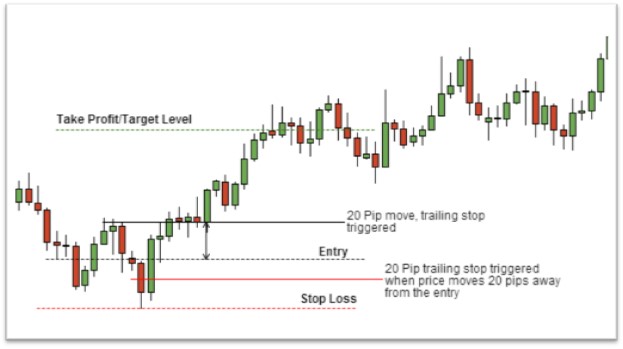
chart showing how risk/reward ratio works

Important Components of the Reward/Risk Ratio

Stop-Loss Orders

Stop-loss orders are an important component of the risk/reward ratio because they limit an investor’s loss on stock and protect their profit. This is accomplished by setting a stop price that when reached, automatically sells the stock as a market order.  For instance, an investor may set the stop price at 10% lower than his entry price; if the market price of the stock drops by further than 10%, the stop order becomes a market order and is sold at the next available opportunity. It is important to note that setting a stop-loss order does not guarantee the safety of your investment as stock prices can plunge rapidly. For example, if an investor bought a share of a stock for $100 and set the stop-loss order at $90, but the stock suddenly drops by 50%, the market order would be prompted and the stock would be sold even though its price would be well below the stop-loss order.

Profit Targets

On the contrary, a profit target is set to ensure an investor will sell in a profitable position. An investor may set a profit target the moment they make a trade or they may add/change a profit target depending on the release of new information concerning the investment. Profit targets are useful in many different ways when it comes to managing risk. For one, in high-risk scenarios, the price of a security can change on the flip of a dime. Therefore, for an investor to sell at a desirable price would require a lot of attention and time that many of us are not able to give. Setting a profit target ensures an investor will sell at his goal price without him/her having to do the work themselves. Secondly, many people buy a share or multiple shares of a stock and wind up gaining profit but aren’t sure when it is time to sell. Investors will sometimes hold out hoping for more profit than already gained, but this can be a dangerous game. Setting a profit target initially will ensure that an investor keeps himself/herself on track to gain profit without great loss.

Bringing It All Together

At the end of the day, each trader is going to have their own risk/reward ratio that best suits their needs and desires, however, using that desired ratio to calculate the stop-loss is what becomes important. For the sake of this example, let’s say our risk/reward ratio is 1:3. If you saw a stock was selling at $30 but was recently priced at $38, and you believe it will again be priced at $38, maybe you would buy a share for a potential reward of $8. To find what your stop-loss would be set at, you would need to divide the profit target ($8) by the ratio (8/3 = 2.67). Then, you would subtract that quotient from the price which you initially bought the share (30 – 2.67) to find your stop-loss ($27.33).

ATGL Chart showing when to enter and exit the market

Many traders make the mistake of not utilizing the risk/reward ratio as they view it as a useless mechanism. In reality, the risk/reward ratio is one of the most powerful trading tools; some would argue it is impossible to trade profitably without it.

Follow the Rules: Above the Green Line + Above 90 Relative Strength

Related Articles

MACD Indicator

MACD Indicator: How To Use Moving Average Convergence Divergence in Trading

The Moving Average Convergence Divergence (MACD) indicator is one of the most widely used technical analysis tools available to traders ...
Read More
Fibonacci Retracement

Fibonacci Retracement: How To Use It for Support, Resistance, and Trade Entries

Knowing how to identify key price levels is critical in any successful trading methodology. Among the most relied-upon tools for ...
Read More
Bollinger Bands

Bollinger Bands: How to Trade Volatility and Spot Breakout Opportunities

Bollinger Bands represent one of the most versatile tools in technical analysis, providing traders with important information about price volatility ...
Read More
Rounding Bottom Pattern

Rounding Bottom Pattern: How to Trade This Gradual Bullish Reversal

In trading, the rounding bottom pattern represents a significant bullish reversal formation that develops gradually over extended periods. This pattern ...
Read More
Rectangle Pattern in Trading

Rectangle Pattern in Trading: How To Identify and Profit from Price Consolidation

In technical analysis, price action often moves in identifiable patterns. Among the most common and reliable is the rectangle pattern ...
Read More
Bullish Pennet Pattern

Bullish Pennant Pattern: How to Trade This Powerful Continuation Signal

The bullish pennant pattern ranks among the most reliable continuation patterns in technical analysis. This pattern signals a temporary pause ...
Read More

November 8, 2019

Fundamental Analysis vs. Technical Analysis

Fundamental Analysis vs. Technical Analysis


By Author

Updated February 8, 2024

When it comes to investing your money, it is important to have a grasp of the basic schools of thought: fundamental analysis and technical analysis. Both approaches differ greatly from one another, yet both are immensely useful depending on your interests and goals.

Fundamental Analysis

Fundamental analysis is named as such because it thoroughly examines a set of basic economic factors, also known as fundamentals, that impact the stock price of a company in the future. Fundamental factors include financial statements, management processes, industries, competitions, business concepts, etc. There are three phases of analysis: the economy, the industry, and the company.

A chart describing the relationship of fundamental analysis to financials, future profitability, economic conditions, and industry
S, Surbhi. “Fundamental Analysis Chart.” Key Differences, 13 Aug. 2019, keydifferences.com/difference-between-fundamental-and-technical-analysis.html

The analysis of the economy examines the general economic condition of the country using economic indicators, the industry is inspected to determine its industry classification in relation to its competitiveness and life cycle, and the company is analyzed to determine whether to buy, hold, or sell based on the financial and non-financial characteristics of the firm. This particular form of analysis is an approach to investment that does not consider short term pricing or trading swings, rather, it is a long term investment strategy. Ultimately, the goal of this form of analysis is to provide the intrinsic value of a stock, gathered by considering both past and present statistics concerning the fundamental factors.

Technical Analysis

Fundamental Analysis
S, Surbhi. “Technical Analysis Chart”

Key Differences, 13 Aug. 2019, keydifferences.com/difference-between-fundamental-and-technical-analysis.html

Similarly to fundamental analysis, technical analysis aims to determine the future price of a stock. However, technical analysis examines differing data and has a varying purpose. Focusing solely on past data, technical analysis considers charts, trends, and patterns to predict the price movements of a share in the near future. This process does not evaluate the company itself, but rather it examines the market activity surrounding the investment. Technical analysis considers the price history of the share, trading volumes over time, industry trading trends, and the width of the change in price. After employing this approach to analysis, the reasons why the price of a share changes become abundantly clear. Thus, the methodology of technical analysis aims to ultimately identify the right time to exit or enter the market and is relevant for only short term investment strategies and trading.

Key Differences

Fundamental and technical analysis differ in many ways, but there are a few key differences that are important to know. As previously stated, fundamental analysis is concerned with aiding long term investment strategies, while technical analysis is utilized for short term trading strategies. The purpose of fundamental analysis is to determine the intrinsic value of a stock, while technical analysis aims to determine when to enter and exit the market.

Which One Is For Me?

Which methodology should you utilize? Well, that depends on a variety of components. For one, if you are an investor you should consider employing fundamental analysis as the process heavily relies on understanding the underlying value of a company which will ultimately drive returns. If you are a trader, you might want to apply the methodology of technical analysis as it examines recent past data to attain near future data and therefore can accurately pinpoint the right time to enter and exit the market. Don’t know if you want to be a trader or an investor? Consider the time commitment. As an investor, you will make long term investments but the effort in maintaining them is little to none. As a trader, you will make short term investments that require frequent and active participation to maintain them. Overall, both fundamental and technical analysis both have their benefits, and when used correctly, are profitable approaches.

Follow the Rules: Above the Green Line + Above 90 Relative Strength

Related Articles

MACD Indicator

MACD Indicator: How To Use Moving Average Convergence Divergence in Trading

The Moving Average Convergence Divergence (MACD) indicator is one of the most widely used technical analysis tools available to traders ...
Read More
Fibonacci Retracement

Fibonacci Retracement: How To Use It for Support, Resistance, and Trade Entries

Knowing how to identify key price levels is critical in any successful trading methodology. Among the most relied-upon tools for ...
Read More
Bollinger Bands

Bollinger Bands: How to Trade Volatility and Spot Breakout Opportunities

Bollinger Bands represent one of the most versatile tools in technical analysis, providing traders with important information about price volatility ...
Read More
Rounding Bottom Pattern

Rounding Bottom Pattern: How to Trade This Gradual Bullish Reversal

In trading, the rounding bottom pattern represents a significant bullish reversal formation that develops gradually over extended periods. This pattern ...
Read More
Rectangle Pattern in Trading

Rectangle Pattern in Trading: How To Identify and Profit from Price Consolidation

In technical analysis, price action often moves in identifiable patterns. Among the most common and reliable is the rectangle pattern ...
Read More
Bullish Pennet Pattern

Bullish Pennant Pattern: How to Trade This Powerful Continuation Signal

The bullish pennant pattern ranks among the most reliable continuation patterns in technical analysis. This pattern signals a temporary pause ...
Read More
  • « Previous Page
  • 1
  • …
  • 11
  • 12
  • 13

Subscribe to Our Newsletter

AGL Logo

Get our eBook Now!

Candlestick - A Swing Traders Friend

We don’t spam! Read our privacy policy for more info.

Check your inbox or spam folder to confirm your subscription.

Voted #1 at Stock Charts

SH Chart
Inverse S&P 500 Fund (SH) will have a Money Wave Buy today.

Help Us Help Animals

Help Us Help Animals

Recent Comments

  • AbovetheGreenLine on Green Line Weekly Aug 27, 2023
  • lbrodt on Green Line Weekly Aug 27, 2023
  • Mitch Van Zelfden on Money Wave Alert! Jul 31, 2023
  • AbovetheGreenLine on Money Wave Alert! Jul 31, 2023
  • Mitch Van Zelfden on Money Wave Alert! Jul 31, 2023

Become a Green Liner!

Help me make more Money in the Stock Market.

Investing with Rules.

On ATGL

  • DashBoard
  • Weekly Commentary
  • Daily Buy / Sell Signals
  • Day Trade Setup
  • Trading Rooms

Strategies

  • Swing Trading
  • ATGL Pick of the Week
  • Dividend Growth
  • ETF Sector Rotation
  • Dogs of the Dow

Help

  • ATGL Trading Rules
  • FAQ
  • Account Maintenance
  • Contact US
  • Join

Stay Updated

No credit card required. Unsubscribe anytime

Check your inbox or spam folder to confirm your subscription.

© 2024 Above The Green Line. All rights reserved.

  • Twitter
  • LinkedIn
  • YouTube