• Market Insights
        • Commentary
          • Daily
          • Weekly
        • BUY / SELL SIGNALS
          • Trade Posts
          • Recent Trade Alerts
          • Recent Day Trades
        • BLOGROLL
          • Dividend Growth Blog
          • ETF Sector Blog
          • Dow Dogs
          • TPOW Blog
  • Strategies
        • SWING TRADING
          • Current Positions
          • Watchlists
          • Closed Positions
          • Candidates - TOP 100
          • Specialty Stocks
        • WEEKLY STOCK PICK
          • TPOW Charts
          • TPOW Performance
          • TPOW Strategy Guide
          • TPOW Performance Dashboard
        • DAY TRADING
          • Watch List
        • ATGL DASHBOARD
        • ETF STRATEGIES
          • ETF Sector Rotation
          • ETF Sector Portfolio
        • DIVIDEND GROWTH
          • Dividend Growth Portfolio
          • Dividend Calendar
        • DOGS OF THE DOW
          • Dogs of the Dow Portfolio
          • DOW 5 Portfolio
  • Markets
        • US MARKET
          • Commodities
          • Energy
          • Precious Metals
          • Volatility
        • GLOBAL MARKETS
          • Market Indices
          • Economic Calendar
          • FOREX Heat Map
          • FOREX Cross Rates
          • Crypto Currency Market
  • Investing
    • Discord Community
    • Dashboard
  • Resources
        • ARTICLES
          • Dividend Growth Model Articles
          • ETF Articles
          • Investment Strategies Articles
          • Market and Economic Insights
          • Stock Trade Articles
          • Stock Reviews
        • TOOLS
          • Stock Scanners
          • Charting Software
          • Brokerage Firms
        • STOCK CHARTS
          • Key Components
          • Reading Charts
          • Drawing Stock Charts
          • Identifying Trends
        • RETIREMENT PLANNING
  • About
    • Contact Us
    • How to Win
    • #1 At Stockcharts
    • Disclaimer
    • FAQ
  • Log In
  • Subscribe
Menu
  • Market Insights
    • Commentary
      • Daily
      • Weekly
    • BUY / SELL SIGNALS
      • Trade Posts
      • Recent Trade Alerts
      • Recent Day Trades
    • BLOGROLL
      • Dividend Growth Blog
      • ETF Sector Blog
      • Dow Dogs
      • TPOW Blog
  • Strategies
    • SWING TRADING
      • Current Positions
      • Watchlists
      • Closed Positions
      • Candidates – TOP 100
      • Specialty Stocks
    • DAY TRADING
      • Watch List
    • WEEKLY STOCK PICK
      • TPOW Charts
      • TPOW Performance
      • TPOW Strategy Guide
      • TPOW Performance Dashboard
    • DIVIDEND GROWTH
      • Dividend Growth Portfolio
      • Dividend Calendar
    • DOGS OF THE DOW
      • Dogs of the Dow Portfolio
      • DOW 5 Portfolio
    • ETF STRATEGIES
      • ETF Sector Rotation
      • ETF Sector Portfolio
    • ATGL DASHBOARD
  • Markets
    • US MARKET
      • Commodities
      • Energy
      • Precious Metals
      • Volatility
    • GLOBAL MARKETS
      • Market Indices
      • Economic Calendar
      • FOREX Heat Map
      • FOREX Cross Rates
      • Crypto Currency Market
  • Investing
    • Discord Community
    • Dashboard
  • Resources
    • ARTICLES
      • Dividend Growth Model Articles
      • ETF Articles
      • Investment Strategies Articles
      • Market and Economic Insights
      • Stock Trade Articles
      • Stock Reviews
    • TOOLS
      • Stock Scanners
      • Charting Software
      • Brokerage Firms
    • STOCK CHARTS
      • Key Components
      • Reading Charts
      • Drawing Stock Charts
      • Identifying Trends
    • RETIREMENT PLANNING
  • About
    • Contact Us
    • How to Win
    • #1 At Stockcharts
    • Disclaimer
    • FAQ
  • Log Out
    • Members-Page
    • Referral
  • Log In
  • Subscribe
Log In
Log Out
Subscribe

December 27, 2020

Effects of a Weakening U.S. Dollar

Effects of a Weakening U.S. Dollar

Source

By Author

Updated February 8, 2024

What Does a Weak U.S. Dollar Mean?

Recently, media outlets have been buzzing about the weakening of the U.S. dollar, but what does that really mean? The term “weak dollar” signifies that, in relation to other currencies, the U.S. dollar is trending downwards. In other words, a weak U.S. dollar can be exchanged for lower amounts of foreign currencies. A Barron’s article published on December 2nd claimed that the U.S. dollar had fallen 10.2% since March 18th; the lowest it has been in over two years.

Why the U.S. Dollar has Weakened

There are many reasons why the value of the U.S. dollar has diminished. In light of the pandemic, analysts hark on the actions of the Fed as well as economic activity. The COVID-19 global pandemic has increased national debt and the U.S.’s relative failure to adequately handle it has caused the country to fall short in relation to other developed nations. As a result, investors have been moving money out of dollars and into gold which in turn weakens the dollar. Furthermore, in March, the Fed cut interest rates to almost zero, causing bonds to be less attractive and narrowing the advantage they held over comparable assets in Europe. The Fed has also been printing more money, resulting in a lower value of the U.S. dollar.

Some analysts believe its plunge is only beginning, expecting further weakening over the next year that will put its value at a historic level that has not been witnessed in over a decade. This forecast is partially due to the recent presidential election, as a Biden administration is expected to reduce uncertainty in international trade policy. Additionally, the U.S. dollar is predicted to continue to weaken if stimulus packages remain insignificant. In relation to other developed nations, the U.S. has fallen short in regard to providing a stimulus package for its constituents. For instance, the European Union agreed to a 700 billion euro ($828 billion) economic stimulus package. Congress, on the other hand, has remained divided and in stalemate; as such, a very small and inadequate stimulus package is expected to pass.

Benefits of a Weakened U.S. Dollar

There is an argument to be made that a weakened U.S. dollar is beneficial for markets and the global economy. A weak and therefore cheap U.S. dollar means that there are more dollars floating around, which causes global monetary conditions to be nice and loose. The benefits will be significantly felt by emerging markets that heavily rely on U.S. dollar accessibility. A weakened U.S. dollar is also beneficial for U.S. exporters as their goods will seem cheaper to foreigners and result in U.S. economic growth and may attract foreign investors to U.S. stocks.

Investors can take advantage of a weakened U.S. dollar in a multitude of ways. For example, investing in commodities may be advantageous for investors. Commodities are priced in U.S. dollars; when the U.S. dollar falls, the price of a commodity rises because it will require more dollars to purchase the commodity. As many investors have already done, turning to gold may prove profitable. Many analysts believe gold will continue to perform as the U.S. dollar sinks, making it a beneficial investment for many Americans. By the same token, cryptocurrencies are gaining traction. Bitcoin, for instance, is denominated in U.S. dollars and as such has an inverse relationship with the value of the dollar.

Consequences of a Weakened U.S. Dollar

According to USA Today, there are few certainties in life: death, taxes, and the dollar’s status as the world’s reserve currency. Yet, the certainty of the U.S. dollar’s reign has recently come into question as it has weakened while the Chinese yuan continues to increase in value. If the dollar were to fall from its perch, interest rates would likely rise for American consumers and businesses, making everything from buying a house to building a factory more expensive. Data shows that more and more Americans feel more certain about the drastic fall of the dollar’s global value. According to the Commodity Futures Trading Commission, hedge fund bets against the dollar in futures markets are at their highest level in almost a decade. Analysts that believe the dollar could lose its global status cite issues far before COVID-19 swept across the planet. Many see the dollar’s potential fall from leadership as a product of increasing volatility within the United States. Trust within the nation has decreased significantly, politics are becoming increasingly more dysfunctional, and U.S. institutions are becoming weaker. Under the Trump administration, global confidence in the U.S. has been undermined and the dollar has suffered accordingly. According to Bloomberg, “the world is having serious doubts about the once widely accepted presumption of American exceptionalism” (2020). Further, World Finance lists three criteria for a reserve currency: it must “play an outsize role in global trade, serve as a global creditor, and have a history of monetary stability” (2020). Particularly after the U.S. – China trade war, the U.S. has considerably failed to meet these requirements. A combination of factors such as these has led many people to bet on the dollar indeed falling from its revered status.

While the U.S. dollar could potentially lose its revered status, some believe it is not likely. There are many reasons why the U.S. dollar could remain prominent, but most significantly, the U.S. is the world’s best customer, contributing largely to the export market and becoming the adopted currency in many other nations. However, a weakened U.S. dollar has other consequences. For one, purchases of foreign goods would result in Americans spending more on goods, which would ultimately increase inflation. When the price of imported products rises and consumer spending falls, retailers may hike the prices of other products to generate more profit, which can only further decline consumer spending. As a large imported good, fuel prices are expected to rise as the nation heavily depends on oil. When the dollar weakens and goods become more expensive, wages could also be lowered or remain stagnant. Odds are, workers could use an increase in wages to pay for higher costs of fuel and other goods, but businesses may not be able to provide increased wages due to the same expenses. As a result, some businesses may have to cut benefits or lay off employees. Lastly, conflicts over currencies have historically led to trade wars where import tariffs are imposed; usually, these trade wars are not productive and do not result in positive gains.

Overall

The U.S. dollar has been weakening throughout 2020 as a result of the global pandemic and its multitude of consequences. A lowered value of the dollar is not the end of the world, but it does have its consequences. Potentially, even, the dollar could fall from its leadership status after decades of reign. At the same time, a weakened U.S. dollar has its benefits; there are many markets that investors can participate in to increase profits despite a devalued dollar. If possible, it is important to continuously examine the dollar’s value in the global economy and take advantage of new opportunities.

Related Articles

MACD Indicator

MACD Indicator: How To Use Moving Average Convergence Divergence in Trading

The Moving Average Convergence Divergence (MACD) indicator is one of the most widely used technical analysis tools available to traders ...
Read More
Fibonacci Retracement

Fibonacci Retracement: How To Use It for Support, Resistance, and Trade Entries

Knowing how to identify key price levels is critical in any successful trading methodology. Among the most relied-upon tools for ...
Read More
Bollinger Bands

Bollinger Bands: How to Trade Volatility and Spot Breakout Opportunities

Bollinger Bands represent one of the most versatile tools in technical analysis, providing traders with important information about price volatility ...
Read More
Rounding Bottom Pattern

Rounding Bottom Pattern: How to Trade This Gradual Bullish Reversal

In trading, the rounding bottom pattern represents a significant bullish reversal formation that develops gradually over extended periods. This pattern ...
Read More
Rectangle Pattern in Trading

Rectangle Pattern in Trading: How To Identify and Profit from Price Consolidation

In technical analysis, price action often moves in identifiable patterns. Among the most common and reliable is the rectangle pattern ...
Read More
Bullish Pennet Pattern

Bullish Pennant Pattern: How to Trade This Powerful Continuation Signal

The bullish pennant pattern ranks among the most reliable continuation patterns in technical analysis. This pattern signals a temporary pause ...
Read More

Dogs of the Dow Portfolio

Dogs of the Dow Portfolio

Dogs of the Dow is a stock-picking strategy that aims to beat the Dow Jones Industrial Average (DJIA) each year by selecting the highest dividend DOW stocks. The strategy produces a portfolio resulting in an equal amount of money being invested in the 10 highest dividend-yielding, blue-chip stocks among the 30 components of the DJIA. At the beginning of each year, the portfolio is re-balanced.

The current Dogs of the Dow, also referred to as the Dow 10, are itemized in the table below. Dividend information for the Dogs of the Dow can be viewed in our Dow10 Dividend Calendar. For the purposes of calculating total return; dividends received during the current investment period are presented. For Real Time charts of companies currently in the Dogs of the Dow Portfolio please visit Dogs of the Dow Charts. Also check out our commentary on Dogs of the Dog blog.

SymbolDescriptionPurchase PriceAmount Invested# SharesLast PriceUnrealized Gain/Loss %Dividend RateCurrent YieldCurrent ValueTotal Dividends ReceivedPay BackidOpen DateStrategyPositionSell DateSell PriceNet ProfitRealized Gain/Loss %ATGL RuleIndustrySCTRSizeCommentsStop LosscolorChartUpdate DateStatusDaily Change %VolumePost TypeATGL 60 MinPortfolio WeightYield on CostProjected Annual DividendsProfit / LossAnnualized Profit/LossStar Rating
Totals  $142,080     $159,739$4,8413.40%                       3.54%$5,06718.66%0.00% 
CSCOCisco Systems$59.27$14,208.00239$79.5134.15%1.632.0501$19,003.00$390.002.75%44392025-01-02Dow10Long$0.000.00%Information TechnologyDow10https://stockcharts.com/h-sc/ui?s=CSCO&p=W&yr=1&mn=6&dy=0&id=p85210974850&a=7151537082025-01-02 14:53:09open0.824216542535Trade 11.90%2.75%$390.0036.49%-
VZVerizon Communications$40.07$14,208.00354$40.140.17%2.726.7825$14,210.00$966.006.81%44402025-01-02Dow10Long$0.000.00%Telecommunication ServiceDogs of the Dow Portfolio.https://stockcharts.com/h-sc/ui?s=VZ&p=W&yr=1&mn=6&dy=0&id=p85210974850&a=7151538972025-01-02 14:55:19open-2.808731770612Trade 8.90%6.79%$963.006.81%-
CVXChevron$149.48$14,208.0097$148.49-0.66%6.844.6064$14,404.00$663.004.58%44412025-01-02Dow10Long$0.000.00%EnergyDogs of the Dow Portfolio.https://stockcharts.com/h-sc/ui?s=CVX&p=W&yr=1&mn=6&dy=0&id=p85210974850&a=7151538012025-01-02 15:30:13open-0.147912639489Trade 9.02%4.58%$663.006.04%-
IBMInternational Business Machine$222.11$14,208.0063$310.4839.79%6.712.1612$19,560.00$423.003.02%44422025-01-02Dow10Long$0.000.00%TechnologyDogs of the Dow Portfolio.https://stockcharts.com/h-sc/ui?s=IBM&p=D&yr=0&mn=6&dy=0&id=p99742941819&a=7785910512025-01-02 15:05:33open0.42054166802Trade 12.25%3.02%$423.0040.64%-
AMGNAmgen Inc.$262.07$14,208.0054$313.8519.76%9.523.0333$16,948.00$514.003.63%44432025-01-02Dow10Long$0.000.00%BiotechnologyDogs of the Dow Portfolio.https://stockcharts.com/h-sc/ui?s=AMGN&p=W&yr=1&mn=6&dy=0&id=p53772931031&a=10915142752025-01-02 15:29:03open-2.29743031761Trade 10.61%3.63%$514.0022.90%-
JNJJohnson & Johnson$145.44$14,208.0097$199.9637.49%5.142.5705$19,396.00$499.003.53%44442025-01-02Dow10Long$0.000.00%Health CareDow 10 Strategyhttps://stockcharts.com/sc3/ui/?s=JNJ&a=1019805126&p=D&yr=0&mn=9&dy=0&id=p766174100442025-02-21 16:20:59open-0.82337509402Trade 12.14%3.53%$499.0040.02%-
KOCoca-Cola Company$62.37$14,208.00227$70.0912.38%2.042.9105$15,910.00$347.002.45%44452025-01-02Dow10Long$0.000.00%Consumer StaplesDow 10 Strategyhttps://stockcharts.com/h-sc/ui?s=KO&p=D&yr=0&mn=6&dy=0&id=p80554201297&a=7785910572025-01-02 15:00:39open-0.227813973044Trade 9.96%3.27%$463.0014.42%-
MRKMerck & Company$100.23$14,208.00141$96.89-3.33%3.243.344$13,661.00$343.002.42%44462025-01-02Dow10Long$0.000.00%Telecommunication ServiceDogs of the Dow Portfolio.2025-01-02 15:12:11open-2.062123517153Trade 8.55%3.23%$457.00-1.44%-
PGProctor Gamble$168.08$14,208.0084$139.63-16.93%4.182.9914$11,729.00$352.002.49%44472025-01-02Dow10Long$0.000.00%TechnologyDogs of the Dow Portfolio.2025-01-02 15:04:57open0.932519221624Trade 7.34%2.49%$351.00-14.97%-
MCDMcDonalds$290.62$14,208.0048$310.796.94%7.172.307$14,918.00$344.002.47%44482025-01-02Dow10Long$0.000.00%TechnologyDogs of the Dow Portfolio.2025-01-02 15:06:12open0.32282355256Trade 9.34%2.47%$344.007.42%-

The Dogs of the Dow are presented below in the pie chart to show both the current allocation and diversification. The percent allocation is automatically updated based on the market and performance of the underlying securities. The initial allocation for the Dow 10 and Dow 5 strategies assumes an equal percentage in each security. Variations from the initial allocation highlights the strength or weakness of a security over time.


Dividends Received by Industry Sector for the Dogs of the Dow portfolio is displayed in the Pie chart below. As dividends are received the pie chart will automatically be updated to reflect the most current receipts aggregated by sector.


Please send some profits to help animals (ASPCA).

August 6, 2020

Short Selling

Short Selling

Source

By Author

Updated February 8, 2024

What is Short Selling?

Short selling is somewhat of an untraditional method of investing that allows investors to profit from securities when they decrease in value. This method of investing is considered quite advanced and should only be undertaken by experienced traders and investors. To short sell, an investor or trader borrows shares of a security that they believe will decrease in value by a predetermined date. The investor then sells the borrowed shares to buyers who are willing to pay the current market price. By the predetermined expiration date of the lending period, the investor is obligated to return the borrowed shares to the lender. At this point, the investor hopes to purchase the shares back at a lower cost and accrue a profit. In order for someone to short sell, an investor must have a margin account. A margin account is a brokerage account where the broker lends their customer money so they can purchase securities. Loans from margin accounts come with periodic interest rates, thus when a short seller is buying back their shares, they must take into consideration the interest of their loan before calculating their profits or losses. Usually, the broker also handles locating the shares and setting the end date of the loan.

Should You Short Sell?

Profitability

This condensed version of short selling makes the process sound fairly simple. You may be wondering why engaging in short selling is not as common for investors as owning a stock. This is because the risks associated are fairly high. Generally, investors purchase stocks that they expect to rise in the future due to the nature of the market. In the long term, the market has historically risen while experiencing small periods of decline. The profitability of short selling usually comes alongside those small periods of decline. If an investor feels confident that a security will drop in price in the near future, short selling becomes a profitable option. In the short term, short selling is a manner of profiting while other investors are watching their portfolios bleed. For example, let’s say stock X is valued at $70.00 and an investor believes that it will drop in price within the next three months. The investor then borrows 100 shares of stock X from a brokerage and sells them to another investor. If the stock drops from $70.00 to $50.00 after three weeks, the investor may decide to buy 100 shares to return to the broker. Not including the interest of the loan, the investor would walk away with $2,000 of profit. The profits gained from short selling can be massive and enticing, yet so can the losses. If stock X instead rose to $80.00, the investor would take a loss of $1,000 and additionally have to pay interest on their loan.

Risks

Short selling can be an incredibly profitable investment decision, but it also carries a risk of great loss. Unlike purchasing shares of stock, investors who short sell can lose more than what they paid for their investment. This means that the losses for an investor who shorted a stock are practically infinite while the losses of an investor who purchased shares of a stock are limited. Additionally, short selling involves borrowing funds which in turn requires opening a margin account. On top of having to pay interest on the loan, an investor has to meet the minimum maintenance requirement of 25%. A maintenance requirement is the minimum amount of funds an investor must maintain within their margin account. If an investor’s account dips below the 25% minimum, a margin call may be forced upon their account. Another risk lies in the trading volume of the stock. If a stock is being actively traded, the investor who shorted it may find themselves having trouble buying back the number of shares loaned to them. If there are many investors who shorted one stock, an influx of buybacks may actually raise the price of the stock. This predicament is referred to as a short squeeze. The last and perhaps most unfortunate risk a short seller may experience is shorting a stock at the wrong time. A stock might have a high probability of dropping in price, but it might not happen within the time period that an investor may expect it to. As such, an investor may short a stock that doesn’t decline before the end date of their loan. Even if the investor does not suffer a loss, they are subjected to the interest rates of the margin account.

Conclusion

Overall, short selling has the potential to provide investors with quick, large profits, yet may also result in quick, large losses. If you are thinking about shorting a financial instrument, be certain to weigh the risks associated. As previously mentioned, the losses from short selling are practically infinite. In accordance with this, short selling is not for everyone and should only be attempted by experienced investors.

Related Articles

MACD Indicator

MACD Indicator: How To Use Moving Average Convergence Divergence in Trading

The Moving Average Convergence Divergence (MACD) indicator is one of the most widely used technical analysis tools available to traders ...
Read More
Fibonacci Retracement

Fibonacci Retracement: How To Use It for Support, Resistance, and Trade Entries

Knowing how to identify key price levels is critical in any successful trading methodology. Among the most relied-upon tools for ...
Read More
Bollinger Bands

Bollinger Bands: How to Trade Volatility and Spot Breakout Opportunities

Bollinger Bands represent one of the most versatile tools in technical analysis, providing traders with important information about price volatility ...
Read More
Rounding Bottom Pattern

Rounding Bottom Pattern: How to Trade This Gradual Bullish Reversal

In trading, the rounding bottom pattern represents a significant bullish reversal formation that develops gradually over extended periods. This pattern ...
Read More
Rectangle Pattern in Trading

Rectangle Pattern in Trading: How To Identify and Profit from Price Consolidation

In technical analysis, price action often moves in identifiable patterns. Among the most common and reliable is the rectangle pattern ...
Read More
Bullish Pennet Pattern

Bullish Pennant Pattern: How to Trade This Powerful Continuation Signal

The bullish pennant pattern ranks among the most reliable continuation patterns in technical analysis. This pattern signals a temporary pause ...
Read More

July 29, 2020

How to Profit from Stock Market Sector Rotation
How to Profit from Stock Market Sector Rotation

Source

By Author

Updated February 8, 2024

What is Sector Rotation?

Sector rotation is the movement of money that has been invested in stocks from one industry to another. In other words, traders and investors move their invested money from one industry to another as they attempt to predict the coming stages of the economic cycle. On a small scale, trends come and go in the market. One type of stock might be popular today and not so popular a month from now. On a large scale, many investors have great profitable success in moving their funds around due to the predictability of the overall economic cycle. In fact, The National Bureau of Economic Research illustrated in a study that economic cycles have been quite consistent since 1854. Thus, utilizing sector rotations comes in various forms: one could try to predict the next fad or one could try to predict the next recession. Many times, investors utilize both.

How to Profit from Stock Market Sector Rotation

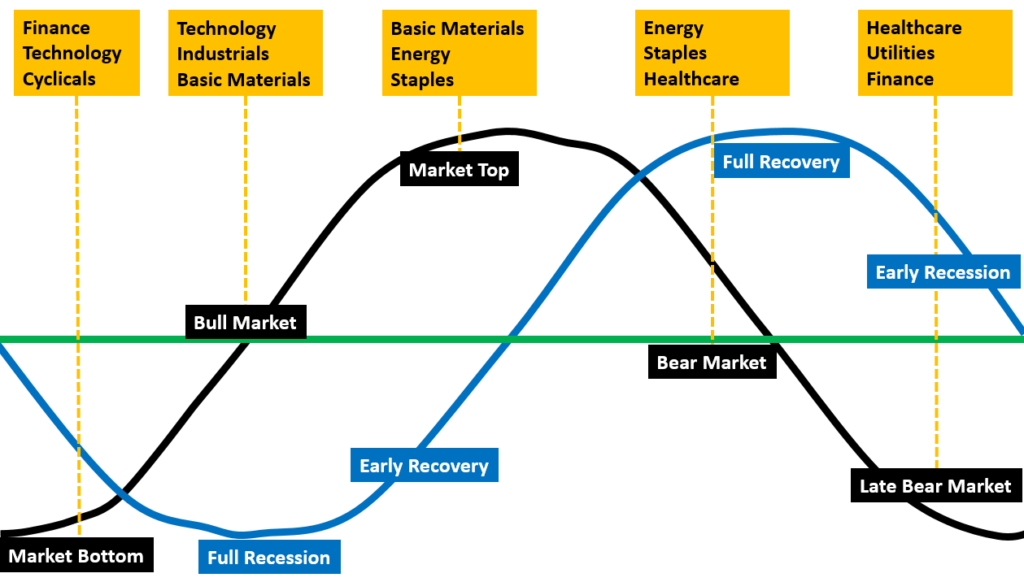
A sector is a part of the economy. As such, an investor can view and invest in various sectors within the stock exchange. There are eleven primary sectors within the market: a materials sector, an industrials sector, an energy sector, a financial sector, a consumer discretionary sector, an information technology sector, a communications services sector, a real estate sector, a health care sector, a consumer staples sector, and a utilities sector. Within each sector are countless stocks from large corporations to small. To profit off of stock market sector rotation, an investor must anticipate the next cycle months in advance. Thus, in order to understand how to profit from stock market sector rotation, one must become aware of the market cycle and economic cycle stages.

The Market Cycle

The market cycle does not move alongside the economic cycle; however, many times they move in anticipation of the economic cycle which is what makes its analysis so crucial. There are four stages to the market cycle. The first is referred to as the “market bottom” where a long-term low is reached. The second is “bull market” where a market rallies from the low. The third is “market top” where a long-term high is reached. And finally, the fourth is “bear market” where the market drops from its high. As previously mentioned, the market cycle attempts to predict the economic cycle anywhere from three to six months into the future. You may have noticed in the recent months after COVID-19 began plaguing the globe, the market rallied all the while the U.S. economy was very much in a recession. It is crucial to never conflate the conditions of the economy to the conditions of the market. The market looks ahead while the economy trails behind.

The Economic Cycle

Similar to the market cycle, there are four main stages of the economic cycle. The first is called “full recession” which basically signifies that things are not going well. During a full recession stage, the GDP is retracting, interest rates are dropping, and it is hard for many people to find or keep jobs. The second stage of the economic cycle is referred to as “early recovery” which alludes to exactly what it sounds like it does: things are beginning to recover from a full recession. During early recovery, production grows, consumer expectations rise, and interest rates bottom. The third stage of the economic cycle is “late recovery” where interest rates might rise exponentially, production flattens, and consumer expectations decline. The final stage of the economic cycle is known as “early recession”. During the early recession phase, the economy is not in great shape, production falls, interest rates peak, and consumer expectations drop to their lowest point.

Within each economic cycle stage, different sectors become profitable. During the full recession stage, transports, technology, and industrials have historically been profitable. During the early recovery stage, industrials, basic materials, and energy have been known to be profitable. During the late recovery stage, energy, consumer staples, and services have historically given investors returns. And lastly, during the early recession stage, services, utilities, and transports have been profitable. You may notice that the last profitable sector carries on to the next economic cycle stage. This is because that sector becomes profitable toward the end of the previous stage and the beginning of the new stage.

Strategy at ATGL

As previously discussed, different sectors of the economy tend to do better than others as the economy moves onward. Investors who seek to beat the market using sector rotation may spend countless hours reading informational articles research reports. At Above The Green Line, we believe in a simpler strategy that involves using ETF’s that are focused on certain sectors. By investing in diversified ETF’s, investors can take advantage of uptrends in certain sectors and reduce their losses on other sectors.

Here is our Green Line Strategy:

Own the strongest 5 ETFs based on their volume and their 1 year Relative Strength
The ETF must be Above the Green Line (250-day ema average), or move to Money Market (CASH)
Every three months rotate to the Strongest ETFs

Below is a simulated backtest of the ATGL ETF Rotation System (Equity in blue) compared to the S&P 500 Index for the last 20 years. Results are NOT actual and may not be similar in the future.

ETF Chart
ETF Rotation System Back Test (Not actual results).

Conclusion

Overall, sector rotation involves anticipating which corporations will become successful in the next stage of the economic cycle. Understanding both the market cycle and the economic cycle carries great importance when attempting to master sector rotation. Their stages highlight a strategy, which if used correctly, can be quite profitable for investors. The principle idea behind sector rotation is to sell highly favored ETF’s and stocks for ones that are lowly favored. Then, hopefully, the lowly favored shares will become favored once again and an investor will walk away with a profit. It can be daunting and terrifying to purchase stocks that most people are selling, but many people have become wealthy from doing just that. The buy low sell high approach is a large part of what made Warren Buffett so successful. Purchasing stocks that have become quite unpopular comes with some degree of risk. Yet, if you succeed, unpopular stocks can eventually yield high returns.

Related Articles

MACD Indicator

MACD Indicator: How To Use Moving Average Convergence Divergence in Trading

The Moving Average Convergence Divergence (MACD) indicator is one of the most widely used technical analysis tools available to traders ...
Read More
Fibonacci Retracement

Fibonacci Retracement: How To Use It for Support, Resistance, and Trade Entries

Knowing how to identify key price levels is critical in any successful trading methodology. Among the most relied-upon tools for ...
Read More
Bollinger Bands

Bollinger Bands: How to Trade Volatility and Spot Breakout Opportunities

Bollinger Bands represent one of the most versatile tools in technical analysis, providing traders with important information about price volatility ...
Read More
Rounding Bottom Pattern

Rounding Bottom Pattern: How to Trade This Gradual Bullish Reversal

In trading, the rounding bottom pattern represents a significant bullish reversal formation that develops gradually over extended periods. This pattern ...
Read More
Rectangle Pattern in Trading

Rectangle Pattern in Trading: How To Identify and Profit from Price Consolidation

In technical analysis, price action often moves in identifiable patterns. Among the most common and reliable is the rectangle pattern ...
Read More
Bullish Pennet Pattern

Bullish Pennant Pattern: How to Trade This Powerful Continuation Signal

The bullish pennant pattern ranks among the most reliable continuation patterns in technical analysis. This pattern signals a temporary pause ...
Read More

July 28, 2020

Is Swing Trading The Best Strategy For You?

Is Swing Trading The Best Strategy For You?

Source

What Is Swing Trading?

Swing trading is a trading style that broadly describes a plethora of short term trading strategies that are ultimately designed to capture gains from a financial instrument. Most commonly exemplified with stocks, swing trading involves purchasing a security and holding onto it for anywhere between a few days to a few weeks. The time frame for swing trades is what drastically differentiates this form of trading from the long term buy-and-hold strategy. Many investors who choose to engage in swing trading inform their decisions utilizing aspects of technical analysis; though, for some investors, additionally employing fundamental analysis can also be beneficial.

The goal of swing trading is to capture a sizeable profit from short term price movements. Thus, depending on the investor’s chosen strategy, investors typically purchase stocks that exhibit various levels of volatility stocks and as such experience quick price fluctuations. Stocks with higher levels of volatility experience quicker price fluctuations and thus tend to be shorter holdings. On the other hand, stocks with lower levels of volatility experience slower price fluctuations and as such tend to be longer swing trade holdings. However, it is important to note that these price fluctuations are not always to the benefit of the investor. Therefore, perhaps the most crucial component of swing trading is an investor’s careful analysis of the stock itself. A precise analysis of a stock aids investors in predicting the likely direction of its price movements as well as the length of time an investor can expect to hold their shares.

Is Swing Trading Right For You?

As of recent, due to increasing technological developments that have given way to online trading platforms, swing trading has become more accessible and more popular among investors. However, its accessibility and popularity do not signify that this trading strategy is beneficial for all. In fact, some would argue that overall swing trading does more harm than good to its participants. Determining whether or not swing trading is right for you all depends on your personality, your lifestyle, and the amount of time you have to dedicate. There is an abundance of information available to investors to guide them through the prospect of swing trading; let’s examine some of the pros and cons together.

Pros

Swing trading has become popular for many investors due to its ability to capture profits from market swings. In other words, traders can maximize their profits in a shorter amount of time rather than waiting for long term investment profits. Swing traders also usually only employ technical analysis for examing potential short term trades, which shortens the time commitment to their investment compared to others that utilize more forms of analysis. For investors who enjoy short term returns and active participation, swing trading can be appealing; for many, it is more appealing than day trading which requires investors to glue themselves to their computers.

Cons

Swing trading comes with a fair amount of risk: the investments are subjected to overnight and weekend risk and at any time can experience abrupt reversals that ultimately may result in a substantial amount of loss. In addition to the level of risk associated with swing trading, there is much evidence to suggest that opting to swing trade rather than buy-and-hold actually hurts your long term performance. Brad Barber and Terrence Odean of the University of California conducted a well-known study that analyzed the returns of over 66,000 households. They discovered that those who traded frequently earned an average annual return of 11.4%, while those who did not earned an average of 16.4%.

Conclusion

For many investors, swing trading is a fun activity that requires a sufficient amount of attention and expertise yet still is not entirely consuming. With the right skills and knowledge, an investor may find themselves successful at swing trading and quickly accruing profits. However, it comes with many risks and does not guarantee profitability. Further, the chances of significantly losing a trade are quite high. As previously stated, a trader’s success lies in their ability to analyze themselves, to question if swing trading suits their lifestyle, personality, and time availability. So if you’re thinking about day trading, be sure to be honest with yourself and realistic with your goals. And if you decide swing trading is for you, check out our swing trading page for more information.


Related Articles

MACD Indicator

MACD Indicator: How To Use Moving Average Convergence Divergence in Trading

The Moving Average Convergence Divergence (MACD) indicator is one of the most widely used technical analysis tools available to traders ...
Read More
Fibonacci Retracement

Fibonacci Retracement: How To Use It for Support, Resistance, and Trade Entries

Knowing how to identify key price levels is critical in any successful trading methodology. Among the most relied-upon tools for ...
Read More
Bollinger Bands

Bollinger Bands: How to Trade Volatility and Spot Breakout Opportunities

Bollinger Bands represent one of the most versatile tools in technical analysis, providing traders with important information about price volatility ...
Read More
Rounding Bottom Pattern

Rounding Bottom Pattern: How to Trade This Gradual Bullish Reversal

In trading, the rounding bottom pattern represents a significant bullish reversal formation that develops gradually over extended periods. This pattern ...
Read More
Rectangle Pattern in Trading

Rectangle Pattern in Trading: How To Identify and Profit from Price Consolidation

In technical analysis, price action often moves in identifiable patterns. Among the most common and reliable is the rectangle pattern ...
Read More
Bullish Pennet Pattern

Bullish Pennant Pattern: How to Trade This Powerful Continuation Signal

The bullish pennant pattern ranks among the most reliable continuation patterns in technical analysis. This pattern signals a temporary pause ...
Read More
  • « Previous Page
  • 1
  • …
  • 10
  • 11
  • 12
  • 13
  • Next Page »

Subscribe to Our Newsletter

AGL Logo

Get our eBook Now!

Candlestick - A Swing Traders Friend

We don’t spam! Read our privacy policy for more info.

Check your inbox or spam folder to confirm your subscription.

Voted #1 at Stock Charts

SH Chart
Inverse S&P 500 Fund (SH) will have a Money Wave Buy today.

Help Us Help Animals

Help Us Help Animals

Recent Comments

  • AbovetheGreenLine on Green Line Weekly Aug 27, 2023
  • lbrodt on Green Line Weekly Aug 27, 2023
  • Mitch Van Zelfden on Money Wave Alert! Jul 31, 2023
  • AbovetheGreenLine on Money Wave Alert! Jul 31, 2023
  • Mitch Van Zelfden on Money Wave Alert! Jul 31, 2023

Become a Green Liner!

Help me make more Money in the Stock Market.

Investing with Rules.

On ATGL

  • DashBoard
  • Weekly Commentary
  • Daily Buy / Sell Signals
  • Day Trade Setup
  • Trading Rooms

Strategies

  • Swing Trading
  • ATGL Pick of the Week
  • Dividend Growth
  • ETF Sector Rotation
  • Dogs of the Dow

Help

  • ATGL Trading Rules
  • FAQ
  • Account Maintenance
  • Contact US
  • Join

Stay Updated

No credit card required. Unsubscribe anytime

Check your inbox or spam folder to confirm your subscription.

© 2024 Above The Green Line. All rights reserved.

  • Twitter
  • LinkedIn
  • YouTube