By ATGL
Updated February 23, 2025
[ez-toc]
When it comes to bond investing, understanding financial metrics can make a significant difference in your decisions. One essential concept is yield to call (YTC), a measure that helps investors evaluate the potential return on callable bonds if they are redeemed early by the bond issuer. This guide will break down what yield to call is, how to calculate it, and why it’s a critical factor in managing your investment portfolio.
Understanding Yield to Call (YTC) and Why It Matters
Yield to call refers to the rate of return an investor can expect if the issuer redeems a callable bond at its callable provision, which allows the bond issuer to repay the bond before its maturity date. Callable bonds are common in the bond market and are often used by issuers to refinance debt when interest rates drop.
Yield to call is one of several metrics used to assess the performance of a bond. For investors unfamiliar with the bond yield definition, it refers to the income return generated from a bond, expressed as a percentage of the bond’s price.
Yield to call provides an accurate estimate of potential earnings if the bond is called, helping to manage expectations around future cash flows. It is especially important when evaluating bonds with fluctuating bond prices, as rate fluctuations can impact whether the bond issuer chooses to exercise the callable provision.
How Does Yield to Call Fit Into Your Portfolio?
In a well-diversified portfolio, understanding yield to call can help balance risk and reward. It complements other measures like current yield, which represents the annual interest earned as a percentage of the bond’s current market price, and yield to maturity, which assumes the bond is held until its maturity date. Together, these metrics provide a comprehensive view of how a bond fits into your broader investment strategy.
Components of Yield to Call
Several factors influence the calculation and interpretation of yield to call:
- Callable Provision: This feature allows the bond issuer to redeem the bond before its maturity. It’s typically exercised when interest rates fall, enabling the issuer to refinance at a lower coupon rate.
- Call Price and Call Date: The call price is the amount paid by the issuer when calling the bond, often slightly higher than the bond’s face value. The call date is the earliest date the bond can be redeemed.
- Interest Rates and Market Conditions: Falling interest rates increase the likelihood of callable bonds being redeemed. This introduces rate risk for investors, as the bond may be called when it is most profitable to hold.
- Credit Risk Profile: The credit risk profile of the bond issuer affects the likelihood of a bond being called. Issuers with higher credit ratings are more likely to refinance their debt if conditions are favorable.
- Bond Prices and Inflation Rate: Inflation rate changes can affect bond prices, potentially leading to a price decline and altering the decision-making process for both investors and issuers.
Yield to Call Formula
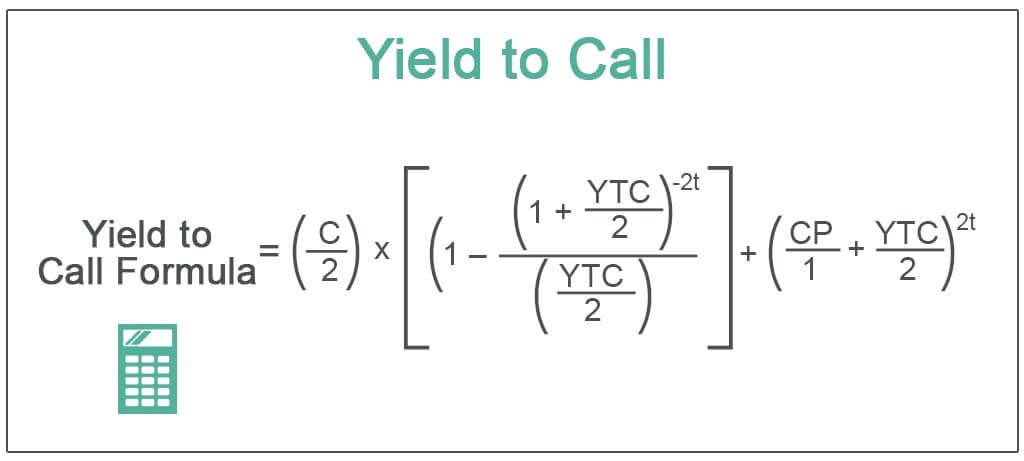
Calculating yield to call involves a formula that considers both the bond’s interest income and the potential capital gain or loss if the bond is called. The formula is:
YTC = (Coupon Payment + (Call Price – Purchase Price) / Years to Call) / (Call Price + Purchase Price) / 2
Variables Explained:
- Coupon Payment: The interest payment made annually by the issuer, determined by the bond’s coupon rate.
- Call Price: The price at which the issuer can redeem the bond.
- Purchase Price: The current market price paid to acquire the bond.
- Years to Call: The number of years until the bond’s call date.
This formula helps calculate the bond’s actual return if it is called early, giving you a clearer picture of its performance compared to its current yield or yield to worst, which is the lowest possible yield an investor can earn on the bond without the bond defaulting.
Practical Examples of Yield to Call Calculations
Example 1: Calculating YTC for a Fixed-Rate Callable Bond
Imagine you’ve purchased a callable bond for $950 with a coupon rate of 5%. The bond has a callable provision allowing it to be called in 5 years at a call price of $1,050.
Using the formula:
- Coupon Payment = $50
- Call Price = $1,050
- Purchase Price = $950
- Years to Call = 5
YTC = (50 + (1050 – 950) / 5)) / (1050 + 950) / 2
Step-by-step:
- Capital gain over 5 years = $100 ÷ 5 = $20/year
- Average price = ($1,050 + $950) ÷ 2 = $1,000
YTC = (50+20)/1000=7%
Here, the bond’s yield to call is 7% annually.
Example 2: Calculating YTC With Rate Fluctuations
If market conditions cause the inflation rate to rise, bond prices may decline. In this next example, the purchase price is adjusted to $900, keeping the same coupon and call price. In this case:
YTC = (50 + (1050 – 900) / 5)) / (1050 + 900) / 2
Updated calculation:
- Capital gain = $150 ÷ 5 = $30/year
- Average price = ($1,050 + $900) ÷ 2 = $975
YTC = (50+30)/975=8.2%
In this scenario, the yield to call improves to 8.2% annually, highlighting the advantage of yield as bond prices fluctuate.
Yield to Call vs. Other Yield Metrics
Yield to call is one piece of a larger puzzle in evaluating bonds. Other important metrics include:
- Current Yield: This measures the bond’s annual interest payments as a percentage of its current market price, offering insight into its immediate return.
- Yield to Maturity: This assumes the bond is held until maturity and includes both interest payments and capital gains or losses.
- Yield to Worst: This represents the lowest potential yield, accounting for scenarios where the bond is called or held to maturity.
Make Smarter Investment Decisions With Above the Green Line
Investing in bonds requires understanding metrics like yield to call to make well-informed choices. Whether you’re managing a diversified portfolio or looking to optimize your returns in the face of rate risk, a solid grasp of these concepts can help you navigate the bond market with confidence.
At Above the Green Line, we’re here to simplify complex financial topics and guide you toward smarter investments. Explore our memberships to access tools and resources designed to help you grow your financial knowledge and achieve your goals.

Related Articles
[pt_view id=”e2b53bb6zw”]