

By ATGL
Updated November 29, 2024
[ez-toc]
The Percentage Price Oscillator (PPO) offers valuable insights into market trends. By comparing the relationship between short-term and long-term price movements, the PPO helps you identify momentum shifts with greater accuracy.
What Is the Percentage Price Oscillator (PPO)?
The PPO is a momentum-based technical indicator that measures the difference between two moving averages of a security’s price, expressed as a percentage of the larger moving average. Unlike the Moving Average Convergence Divergence (MACD), which uses absolute price differences, the PPO provides a normalized view, allowing for more effective comparisons across different securities and timeframes.
PPO Formula and Calculation Examples
How Do You Calculate PPO?
The PPO is calculated using the following formula:
PPO = [(Short-term EMA – Long-term EMA) / Long-term EMA] × 100
Where:
- EMA stands for Exponential Moving Average
- Short-term EMA typically refers to the 12-period EMA
- Long-term EMA typically refers to the 26-period EMA
By expressing the difference as a percentage, the PPO facilitates a clearer understanding of the relationship between short-term and long-term price movements. This normalization is particularly useful when analyzing securities with varying price levels, as it mitigates the impact of absolute price differences.
The PPO generates values that oscillate above and below the zero line, indicating bullish or bearish momentum:
- Positive PPO values suggest that the short-term EMA is above the long-term EMA, indicating upward momentum.
- Negative PPO values imply that the short-term EMA is below the long-term EMA, signaling downward momentum.
Example Calculation
Assume an investor is analyzing a stock with the following data:
- 12-period EMA: $50
- 26-period EMA: $48
If they apply the PPO formula, they get PPO = [($50 – $48) / $48] × 100 = 4.17%
This result shows a positive PPO value of 4.17%, indicating that the short-term price movement is stronger than the long-term trend, suggesting bullish momentum.
Tools for Calculating PPO
While manual calculation is straightforward, most traders rely on technical analysis platforms or trading software to compute the PPO automatically. Platforms like MetaTrader, TradingView, and Thinkorswim provide PPO as a built-in indicator, allowing for real-time analysis without manual effort.
How To Interpret the PPO Technical Indicator
Here’s how you can interpret key PPO signals:
- Positive PPO Values: When the PPO is above zero, it indicates that the short-term EMA is greater than the long-term EMA, signaling upward momentum.
- Negative PPO Values: A PPO below zero shows that the short-term EMA is lower than the long-term EMA, reflecting downward momentum.
- Zero Line Crossovers: When the PPO crosses above the zero line, it can be interpreted as a buy signal, as it suggests a shift from a bearish to a bullish trend. Conversely, a cross below the zero line may indicate a sell signal.
- Bullish Divergences: Bullish divergences occur when the price of a security makes a lower low while the PPO makes a higher low. This scenario suggests weakening bearish momentum and potential reversal to the upside.
- Bearish Divergences: Bearish divergences happen when the price makes a higher high while the PPO makes a lower high. This pattern indicates a slowdown in bullish momentum, potentially signaling an upcoming reversal to the downside.
- Overbought Conditions: When the PPO reaches unusually high levels, it may suggest that the security is overbought, and a correction could be imminent. Traders often use these signals to anticipate pullbacks in an uptrend.
- Oversold Conditions: Conversely, extremely low PPO values may indicate that a security is oversold, suggesting that the current downtrend may be losing steam and a reversal could occur.
Using PPO in Trading Strategies
By integrating the PPO with other indicators and applying it across different market conditions, you can optimize entry and exit points to improve overall performance.
- Confirmation With Other Indicators: The PPO works well when combined with indicators like the Relative Strength Index (RSI) or MACD. For instance, if the PPO shows bullish momentum and the RSI indicates an oversold condition, this combination can reinforce a buy signal, helping to validate trading decisions.
- Timing Entries and Exits: The PPO is particularly useful for timing trades. Traders might enter when the PPO crosses above the zero line, signaling upward momentum, and exit when it begins to decline or crosses below the zero line, indicating weakening momentum.
- Enhancing Trend-Following Strategies: Trend-following strategies often rely on moving averages to identify the direction. The PPO enhances these by comparing short-term and long-term trends as a percentage. Traders can stay in a trade as long as the PPO remains positive, exiting when it turns negative to lock in gains.
Benefits of Using the PPO
Unlike absolute indicators, the PPO expresses the difference between EMAs as a percentage, making it easier to compare across different stocks, commodities, or indices, regardless of their price levels.
In addition, the PPO can be applied to various timeframes, making it suitable for both short-term traders and long-term investors.
And, due to its calculation method, the PPO can often detect shifts in momentum earlier than some other indicators, providing traders with a timely advantage in volatile markets.
Limitations of the PPO
While the PPO is a powerful indicator, it is not without its limitations.
- Lagging Nature: Like all moving averages, the PPO is based on past price data. This can sometimes result in delayed signals, particularly in fast-moving markets.
- False Signals: In choppy or sideways markets, the PPO can generate false signals, leading to potential losses. It is often best used in trending markets where its signals are more reliable.
- Dependence on EMA Settings: The effectiveness of the PPO can vary depending on the chosen EMA periods. Traders must test and adjust these settings based on the specific security and market conditions to optimize results.
PPO Indicator vs. MACD Comparison
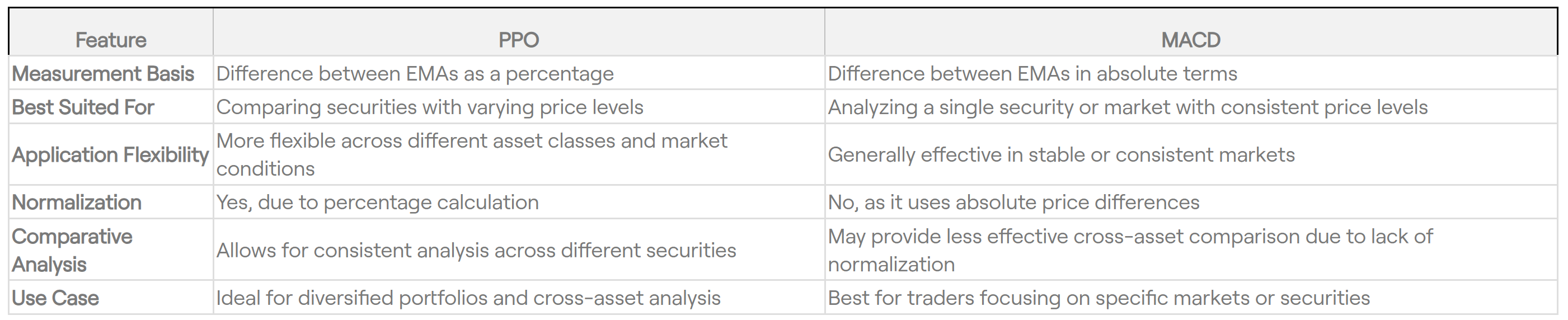
The PPO and the MACD are closely related indicators, both used to measure momentum and trend direction. However, they differ in ways that affect their application.
The PPO expresses the difference between EMAs as a percentage, making it more suitable for comparing securities with different price levels. The MACD uses absolute price differences, which can make it less effective for cross-asset comparisons.
The PPO’s percentage-based approach allows it to be more flexible across different asset classes and market conditions. The MACD, while popular, is often more effective in markets where price levels are consistent.
Is PPO better than MACD? The answer depends on a trader’s objectives. If you’re comparing securities with significantly different price ranges, the PPO might offer a more consistent analysis. However, if you’re focused on a single market or security, the MACD’s absolute measure could be sufficient.
Reap the Benefits of Successful Trading Strategies
By integrating the PPO indicator into your trading toolkit, you enhance your ability to identify trends, time your trades more effectively, and improve your overall trading performance. At Above the Green Line, we provide our members with access to advanced technical analysis tools to support successful trading strategies. To learn more and take your trading to the next level, explore our membership options.

Related Articles
[pt_view id=”9517038dwu”]